

Cecília Francini Cabral de Vasconcellos; Luiza Fattori; Edivaldo Rocha; Ana Beatriz Lobo; Juliana Maria Ferraz Sallum
DOI: 10.17545/eOftalmo/2026.v12.0019
ABSTRACT
PURPOSE: To investigate the prevalence of anxiety and depression symptoms and their associated sociodemographic and clinical factors among individuals with visual impairment in Brazil.
METHODS: This cross-sectional study included 730 individuals aged 18-80 years with visual impairment. Symptoms of anxiety and depression were assessed using the Hospital Anxiety and Depression Scale. Associations between psychological symptoms and sociodemographic and clinical characteristics, including severity and duration of visual impairment and participation in rehabilitation programs, were analyzed.
RESULTS: Clinically significant anxiety symptoms were identified in 56% of participants, whereas depressive symptoms were observed in 40.8%. Anxiety symptoms were significantly associated with female sex, widowhood, low vision, a recent diagnosis of visual impairment, and lack of participation in rehabilitation. Depressive symptoms were associated with female sex, widowhood, older age, disability retirement, blindness, duration of visual impairment between 5 and 10 years, and absence of rehabilitation.
CONCLUSIONS: Anxiety and depressive symptoms were highly prevalent among individuals with visual impairment. Anxiety was more common among participants with less severe and more recently diagnosed visual impairment, whereas depression was associated with more severe and longer-standing impairment. Participation in rehabilitation appeared to be protective against both conditions, underscoring the importance of expanding access to rehabilitation services and integrating mental health care into vision rehabilitation programs.
Keywords: Visual impairment; Anxiety; Depression; Mental health; Rehabilitation; Brazil
RESUMO
OBJETIVOS: Analisar a prevalência de ansiedade e depressão e seus fatores sociodemográficos e clínicos associados em pessoas com deficiência visual no Brasil.
MÉTODOS: Estudo transversal realizado com 730 pessoas com deficiência visual, entre 18 e 80 anos. Os sintomas de ansiedade e depressão foram avaliados pela Escala Hospitalar de Ansiedade e Depressão (HADS). Foram investigadas associações com variáveis sociodemográficas e clínicas, incluindo gravidade da deficiência visual, tempo de diagnóstico e participação em reabilitação.
RESULTADOS: Sintomas clinicamente relevantes de ansiedade foram identificados em 56% dos participantes e sintomas depressivos em 40,8%. A ansiedade associou-se ao sexo feminino, viuvez, baixa visão, diagnóstico recente e ausência de reabilitação. A depressão associou-se ao sexo feminino, viuvez, idade mais avançada, aposentadoria por invalidez, cegueira, tempo de deficiência entre cinco e dez anos e ausência de reabilitação.
CONCLUSÕES: Sintomas sugestivos de ansiedade e depressão apresentaram elevada prevalência entre pessoas com deficiência visual. A ansiedade predominou em casos menos graves e de início recente, enquanto a depressão esteve associada à maior gravidade e duração da deficiência. A reabilitação mostrou-se fator protetivo, reforçando a necessidade de ampliar seu acesso e integrar estratégias de saúde mental ao cuidado da deficiência visual.
Palavras-chave: Deficiência visual; Ansiedade; Depressão; Saúde mental; Reabilitação; Brasil.
INTRODUCTION
Visual impairment, defined by the World Health Organization (WHO) as an alteration of visual function resulting from anatomical, physiological, or optical factors affecting the visual system and its functions, represents a major global health condition1. The WHO classifies visual impairment into two main categories: blindness, characterized by best-corrected visual acuity in the better eye of less than 6/120 or a visual field of less than 10º; and low vision, corresponding to best-corrected visual acuity between 6/18 and 6/120 or a visual field between 10º and 20º2,3. This distinction is important because the needs and experiences of individuals who are blind and those with low vision may differ significantly, substantially influencing their interaction with the environment and their psychosocial well-being4.
The main causes of visual impairment worldwide include unoperated cataract, uncorrected refractive errors, age-related macular degeneration, glaucoma, and diabetic retinopathy1,5,6. The prevalence of visual impairment is higher in low- and middle-income regions, where access to preventive and treatment services is limited, and is estimated to be up to four times higher than that in high-income regions1. In Brazil, the 2022 Demographic Census conducted by the Instituto Brasileiro de Geografia e Estatística reported that 7.9 million Brazilians had great difficulty seeing, highlighting the magnitude of this condition in the country7,8.
Vision loss has a profound impact on individuals' quality of life by limiting autonomy in activities of daily living, mobility, social participation, and engagement in productive activities9,10. Studies have shown that people with visual impairment have significantly lower quality-of-life scores than the general population11-13. This reduction in quality of life is frequently associated with an increased risk of developing mental disorders, particularly anxiety and depression14,15.
A systematic review and meta-analysis revealed that the prevalence of depression among people with visual impairment is approximately 27%, considerably higher than the 17% reported in the general population16. Similarly, the prevalence of anxiety disorders is also higher, with studies indicating that individuals with visual impairment are twice as likely to develop an anxiety disorder as those without visual impairment17,18.
The association between visual impairment and mental disorders is multifactorial, involving not only the practical difficulties imposed by sensory loss but also the psychosocial effects of stigma, social isolation, and loss of social roles. Adaptation to vision loss is a complex and individualized process that may be influenced by the severity and cause of the impairment, duration of the condition, access to rehabilitation services, and perceived social support19,20. Rehabilitation has been associated with a lower prevalence of anxiety and depressive symptoms, as well as better mental health outcomes and quality of life, by promoting the development of adaptive skills and social reintegration21,22. However, access to these services remains a challenge for a large proportion of the population with visual impairment in Brazil.
Despite the robust international literature on this topic, the Brazilian context may differ considerably from that of developed countries. Brazil has marked regional inequalities that directly affect the distribution and quality of healthcare services. Access to visual rehabilitation is uneven and is often concentrated in large urban centers, placing individuals in peripheral and rural regions at a disadvantage. Furthermore, socioeconomic disparities and structural limitations of the Unified Health System (Sistema Único de Saúde) in providing continuous and comprehensive visual rehabilitation may further increase the psychosocial vulnerability of these individuals. Understanding these local characteristics is essential for contextualizing the impact of visual impairment on the mental health of the Brazilian population22.
Given the high prevalence of visual impairment in Brazil and its impact on mental health and quality of life, studies investigating the prevalence of anxiety and depression and their associated factors in this population are warranted. Such evidence is important for informing public policies and developing more effective interventions to promote mental health and psychosocial well-being among people with visual impairment.
Therefore, this study aimed to investigate the prevalence of anxiety and depression symptoms among individuals with visual impairment in Brazil and to analyze the associations of these outcomes with sociodemographic and clinical variables, including age, sex, income, education, marital status, geographic region, employment status, severity of vision loss, time since the onset of impairment, cause of impairment, and participation in a rehabilitation program.
METHODS
This quantitative, cross-sectional, analytical, and observational study was conducted to investigate the prevalence of anxiety and depression symptoms and their associated factors among individuals with visual impairment in Brazil. The study was approved by the Research Ethics Committee of H.Olhos Paulista (Approval No. 7.814.027).
Sample
The sample consisted of 730 participants with self-reported visual impairment (blindness or low vision) residing across all geographic regions of Brazil. Participants were recruited using nonprobability convenience sampling. The final sample included individuals who met the eligibility criteria and completed all study instruments.
Inclusion and exclusion criteria
The inclusion criteria were as follows: (a) age ≥18 years; (b) self-reported visual impairment, classified as blindness or low vision; (c) residence in Brazil; and (d) provision of electronic informed consent.
The exclusion criteria were (a) incomplete questionnaire responses that precluded analysis of the primary outcomes (anxiety and depression), (b) absence of self-reported visual impairment, and (c) the presence of another disability that could confound the analysis of the impact of visual impairment.
Instruments
Data were collected using a structured online questionnaire consisting of two sections.
1. Sociodemographic and Clinical Questionnaire: This questionnaire was developed by the researchers to characterize the study sample. The sociodemographic variables included age (years), sex (female or male), income (number of minimum wages per person), educational level (elementary school, high school, higher education, etc.), marital status (married, single, separated, or widowed), employment status (employed, student, retired, unemployed, etc.), and geographic region of residence in Brazil (North, Northeast, Central-West, Southeast, or South).
The clinical variables included severity of visual impairment (low vision or blindness), time since onset of the impairment (1 year to >10 years), cause of impairment (congenital or acquired, with specification of etiology), and previous participation in a visual habilitation or rehabilitation program (yes or no).
2. Hospital Anxiety and Depression Scale (HADS): The HADS was used to assess the presence and severity of anxiety and depression symptoms. This instrument has been validated for use in the Brazilian population23 and is widely used in clinical practice and research. It consists of 14 items, divided into two seven-item subscales: the HADS-Anxiety (HADS-A) and HADS-Depression (HADS-D) subscales. Each item is scored on a four-point Likert scale (0-3), yielding a total score ranging from 0 to 21 for each subscale. Scores were classified as follows: 0-7, unlikely (normal); 8-10, possible (mild); and 11-21, probable (moderate to severe) anxiety or depression24.
Procedures
The study protocol was approved by a Research Ethics Committee (Approval No. 6.260.956). Data were collected online using Google Forms between February and October 2025. The questionnaire link was widely distributed through social media, online discussion groups, and partnerships with organizations supporting individuals with visual impairment throughout Brazil, including Bengala Verde Brasil, Retina Brasil, Tocando em Frente, Grupo Virtual Stargardt, and Associação de Deficientes Visuais e Amigos.
The first page of the questionnaire contained the electronic Informed Consent Form, which described the study objectives, procedures, potential risks and benefits, and measures to ensure participant anonymity and data confidentiality. Participation was voluntary, and completion of the questionnaire was considered to indicate informed consent.
Data analysis
The data were entered into and analyzed using IBM SPSS Statistics version 25.0. Descriptive analyses were performed to characterize the study sample, and categorical variables are presented as absolute (n) and relative (%) frequencies.
For the inferential analyses, Pearson's chi-square test or Fisher's exact test (when the expected frequency was <5 in more than 20% of the contingency table cells) was used to evaluate the associations between the sociodemographic and clinical variables (independent variables) and the anxiety and depression outcomes (dependent variables), categorized as unlikely, possible, and probable. Statistical significance was defined as p<0.05. A multivariable logistic regression analysis was initially considered; however, the low frequency of observations across several categories prevented adequate model fitting, resulting in an unstable and uninterpretable model.
RESULTS
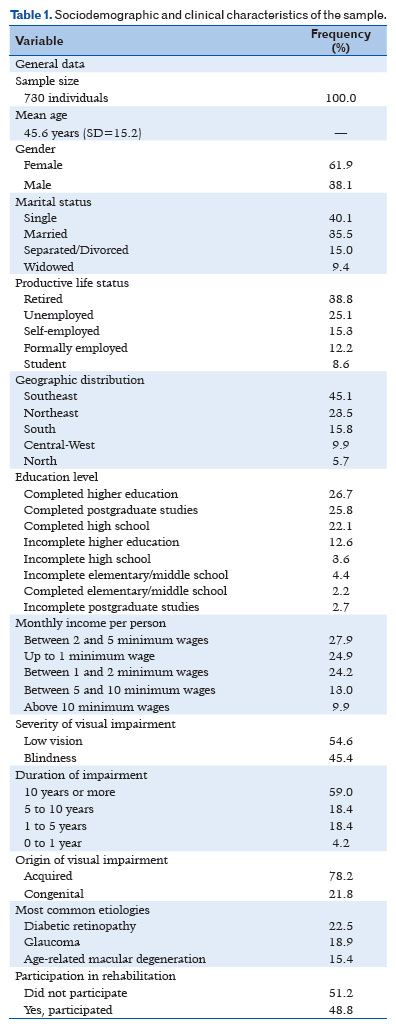
The sample consisted of 730 individuals with visual impairment. The majority of participants were female (61.9%), with a mean age of 45.6 years (SD=15.2). Regarding marital status, most participants were single (40.1%), followed by married (35.5%), separated/divorced (15.0%), and widowed (9.4%). With respect to employment status, the largest proportion of participants were retired (38.8%), followed by unemployed (25.1%), self-employed (15.3%), formally employed (12.2%), and students (8.6%). Participants were recruited from all five geographic regions of Brazil, with the highest proportion residing in the Southeast (45.1%), followed by the Northeast (23.5%), South (15.8%), Central-West (9.9%), and North (5.7%).
Regarding educational attainment, 26.7% of participants had completed higher education, 25.8% had completed postgraduate education, and 22.1% had completed high school. The remaining participants had incomplete higher education (12.6%), incomplete postgraduate education (2.7%), incomplete high school (3.6%), completed elementary school (2.2%), or incomplete elementary school (4.4%).
Regarding monthly per capita income, 27.9% of participants reported earning between 2 and 5 minimum wages. In addition, 24.9% earned up to 1 minimum wage, 24.2% earned between 1 and 2 minimum wages, 13% earned between five and 10 minimum wages, and 9.9% earned more than 10 minimum wages.
Regarding the clinical characteristics, low vision was slightly more common than blindness (54.6% vs. 45.4%). Most participants (59%) had been living with visual impairment for 10 years or longer. An additional 18.4% had experienced visual impairment for 5-10 years, 18.4% for 1-5 years, and 4.2% for less than 1 year. Acquired visual impairment accounted for 78.2% of cases, with diabetic retinopathy (22.5%), glaucoma (18.9%), and age-related macular degeneration (15.4%) being the most common etiologies. Congenital causes accounted for 21.8% of the sample. Only 48.8% of participants reported having undergone habilitation or rehabilitation, indicating that more than half had not participated in these services (Table 1).
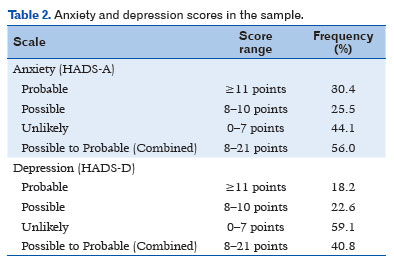
Analysis of the Hospital Anxiety and Depression Scale (HADS) scores revealed a high prevalence of anxiety and depression symptoms in the study sample.
For the anxiety subscale (HADS-A), 30.4% of participants scored in the probable range (≥11 points), indicating clinically significant anxiety symptoms. An additional 25.5% were classified as possible (8-10 points), whereas 44.1% were classified as unlikely (0-7 points). Overall, approximately 56% of participants had anxiety symptoms ranging from possible to probable.
For the depression subscale (HADS-D), 18.2% of participants were classified as probable (≥11 points), suggesting clinically significant depressive symptoms. In addition, 22.6% were classified as possible (8-10 points), whereas 59.1% were classified as unlikely (0-7 points). Overall, approximately 41% of participants had depressive symptoms ranging from possible to probable (Table 2).
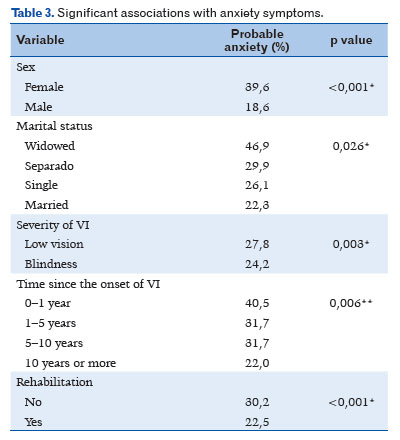
The association analysis revealed statistically significant associations between anxiety symptoms and several sociodemographic and clinical variables. A significantly higher prevalence of probable anxiety was observed among females (39.6%) than among males (18.6%; p<0.001). Regarding marital status, widowed individuals showed the highest prevalence of probable anxiety (46.9%; p=0.026). Participants with low vision were more likely to present probable anxiety symptoms than those with blindness (27.8% vs. 24.2%; p=0.003). Time since the onset of visual impairment was also significantly associated with anxiety, with the highest prevalence observed among individuals diagnosed within the previous year (40.5%), followed by a gradual decrease over time (p=0.006). Finally, individuals who had not participated in a rehabilitation program had a significantly higher prevalence of probable anxiety than those who had participated (30.2% vs. 22.5%; p<0.001).
No statistically significant associations were found between anxiety symptoms and age group (p=0.201), geographic region (p=0.625), income (p=0.062), or employment status (p=0.452; Table 3).
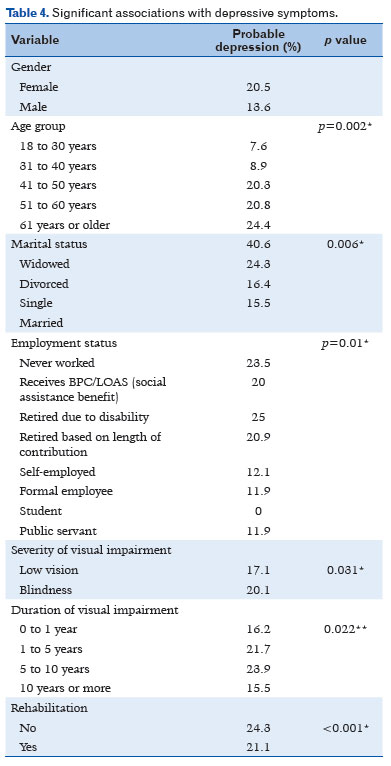
The analysis of depressive symptoms also identified several significant associations. Females had a significantly higher prevalence of probable depression than males (20.5% vs. 13.6%; p=0.014). Regarding age, participants aged 61 years or older had the highest prevalence of probable depression (24.4%), followed by those aged 51-60 years (20.8%) and 41-50 years (20.3%), with a significant association between age and depression (p=0.002). Regarding marital status, widowed participants showed the highest prevalence of probable depression (40.6%), followed by separated/divorced participants (24.3%; p=0.006). With respect to employment status, individuals receiving disability retirement benefits (25.0%) and those who had never worked (23.5%) had the highest prevalences of probable depression (p=0.010).
Regarding the severity of visual impairment, participants with blindness had a higher prevalence of probable depression than those with low vision (20.1% vs. 17.1%; p=0.031). Time since the onset of visual impairment was also significantly associated with depressive symptoms, with the highest prevalence observed among participants with a duration of impairment of 5-10 years (23.9%), followed by those with 1-5 years (21.7%; p=0.022). Finally, participants who had not undergone habilitation or rehabilitation had a significantly higher prevalence of probable depression than those who had participated in these services (24.3% vs. 21.1%; p<0.001, Table 4).
DISCUSSION
The present study provides an overview of the mental health of individuals with visual impairment in Brazil, demonstrating a high prevalence of clinically relevant symptoms of anxiety and depression, including both possible and probable cases according to the HADS criteria. These rates exceed those reported in the general population and are consistent with international estimates. A particularly important finding of this study is the association between the absence of rehabilitation and higher prevalences of anxiety and depression. This may represent the most clinically relevant finding, highlighting the potential role of rehabilitation not only in functional adaptation but also in improving mental health outcomes among individuals with visual impairment.
The sample, predominantly composed of retirees and individuals with acquired visual impairment, reflects a context of vulnerability characterized by disrupted work trajectories and the loss of social and economic roles, which are well-established risk factors for psychological distress among individuals with disabilities9.
Unemployment and unplanned retirement have been associated with poorer mental health outcomes, including increased rates of anxiety and depression, potentially mediated by reduced social participation and financial stress15. Furthermore, the predominance of chronic and progressive conditions may contribute to uncertainty and persistent stress, reinforcing the concept of vision loss as a dynamic process that requires continuous adaptation and may gradually deplete psychological resources over time25-27.
Despite the relatively high educational level of the sample, no significant association was found between educational attainment and anxiety or depression. This finding suggests that, although education may enhance cognitive resources and coping strategies, it may not offset the psychosocial impact of structural barriers such as unemployment and social exclusion. Similarly, income was not significantly associated with anxiety, raising the possibility that income stability may be more important than absolute income. Therefore, the relationship between socioeconomic status and mental health in this population appears to be complex and potentially nonlinear25-27.
The prevalence rates identified in this study were higher than those reported for the Brazilian general population, with more than half of the participants screening positive for anxiety symptoms and approximately 41% screening positive for depressive symptoms when possible and probable HADS classifications were considered. These findings are consistent with international studies demonstrating an increased risk of anxiety and depression among individuals with visual impairment across different settings16-18. In Brazil, these outcomes may be further exacerbated by barriers to healthcare and rehabilitation services, particularly in low- and middle-income settings5,9.
The analysis of associated factors revealed a multifactorial pattern. The higher prevalence of anxiety and depression among women is consistent with previous studies, suggesting a combined effect of gender-related inequalities and disability-related barriers, which may increase social isolation and reduce access to opportunities. Widowhood also emerged as an important associated factor, reflecting the loss of social support and the increased vulnerability to psychological distress28,29.
Distinct patterns were observed for anxiety and depression. Anxiety was more strongly associated with low vision and a recent diagnosis, whereas depression was associated with blindness and a longer duration of visual impairment. This difference deserves further consideration. Higher anxiety among individuals with low vision may be related to fear of disease progression, uncertainty regarding future vision loss, and the functional instability associated with this condition, resulting in a persistent state of vigilance30. In contrast, the higher prevalence of depression among individuals with blindness may reflect incomplete adaptation or the cumulative effects of severe functional limitations, restricted social participation, and persistent daily challenges22,31. Recent reviews have emphasized that psychosocial adaptation to vision loss is a continuous and complex process influenced by both clinical and emotional factors32.
As noted above, participation in rehabilitation was consistently associated with better mental health outcomes, with lower prevalences of both anxiety and depression. This finding agrees with previous evidence showing that rehabilitation improves not only functional capacity but also psychological well-being and quality of life21. By promoting autonomy, coping skills, and social participation, rehabilitation may address key mechanisms involved in the development of mental disorders. However, the possibility of reverse causality and selection bias should be considered. Individuals with greater psychological resilience or more favorable baseline mental health may be more likely to seek rehabilitation services. Therefore, rehabilitation alone cannot be assumed to explain the better psychological outcomes observed32. Moreover, only about half of the participants reported having undergone rehabilitation, highlighting an important gap in service provision and a missed opportunity for prevention and comprehensive care9,22.
This study has several limitations that should be acknowledged. First, because of its cross-sectional design, causal relationships cannot be established, and reverse causation cannot be excluded. Second, the use of convenience sampling and online data collection may have introduced selection bias and limited the generalizability of the findings. Third, reliance on self-reported information without clinical confirmation may have affected measurement accuracy. Finally, the predominance of female, retired participants from the Southeast region may further limit the applicability of the findings to other populations.
Four methodological limitations deserve particular emphasis. First, the study relied on self-reported visual impairment without objective clinical confirmation of visual acuity, visual field, or ophthalmologic diagnosis. Participants may have interpreted technical terms such as low vision, blindness, and visual impairment differently, potentially introducing heterogeneity in the classification of visual impairment severity.
Second, participants were recruited through organizations such as Bengala Verde Brasil, Retina Brasil, Grupo Virtual Stargardt, and other patient associations. This recruitment strategy may have favored individuals who were more actively engaged in support groups, social media, or healthcare services and those with higher educational attainment. Consequently, the sample may not fully represent the broader Brazilian population with visual impairment, potentially overestimating social support while underestimating the prevalence of mental health disorders among more socially isolated individuals.
Third, although multivariable logistic regression analysis was considered, the sample size and sparse distribution of observations across several categories prevented adequate model fitting, resulting in unstable parameter estimates. Consequently, the findings are based on univariate analyses and could not be adjusted for potential confounding factors.
Finally, all causes of visual impairment were analyzed together. Different ophthalmologic conditions, such as retinitis pigmentosa, Stargardt disease, glaucoma, optic neuropathies, and diabetic retinopathy, may have distinct psychosocial effects. Future studies should investigate these conditions separately, as they may require tailored mental health interventions and rehabilitation strategies.
Future studies should adopt longitudinal designs and representative samples to better understand causal pathways and long-term outcomes. Despite these limitations, the present findings underscore the importance of integrated approaches that combine rehabilitation, mental healthcare, and social inclusion strategies to reduce the burden of anxiety and depression among individuals with visual impairment in Brazil.
In conclusion, this study demonstrated a high prevalence of clinically relevant anxiety and depression symptoms, including both possible and probable HADS cases, with rates exceeding those reported for the general Brazilian population and consistent with international findings. These results highlight the need for greater clinical and public health attention to the mental health of individuals with visual impairment.
The associated factors suggest a risk profile that combines sociodemographic characteristics, including female sex, widowhood, and labor inactivity, with clinical factors such as the severity and duration of visual impairment. Two distinct patterns were identified: an anxiety profile associated with low vision and recent diagnosis, and a depression profile associated with blindness, longer disease duration, and older age. Recognizing these patterns may facilitate risk stratification and the development of targeted interventions.
Participation in rehabilitation was consistently associated with a lower prevalence of anxiety and depressive symptoms. Its potential benefits extend beyond improving visual function to supporting autonomy and psychosocial adaptation. However, the relatively low participation rate highlights an important, missed opportunity for prevention and comprehensive care.
Integrating rehabilitation with psychosocial support services and implementing systematic mental health screening from the time of diagnosis may facilitate the early identification of individuals at risk, improve access to appropriate care, and ultimately promote better mental health outcomes and quality of life for people with visual impairment in Brazil.
ACKNOWLEDGMENT
The authors would like to thank Bengala Verde Brasil, a non-profit organization, for its support through the donation of resources for research materials and data analysis.
REFERENCES
1. World Health Organization (2023). Blindness and vision impairment. WHO. Disponível em: https://www.who.int/news-room/fact-sheets/detail/blindness-and-visual-impairment
2. World Health Organization (1992). International statistical classification of diseases and related health problems, tenth revision (ICD-10). WHO. Disponível em: https://iris.who.int/items/5858156c-f66b-43cc-be2c-37710e5cd2e6
3. Dandona L, Dandona R. Revision of visual impairment definitions in the International Statistical Classification of Diseases. BMC Med. 2006 Mar 16:4:7.
4. Senra H, Hernandez-Moreno L, Moreno N, Macedo AF. Anxiety levels moderate the association between visual acuity and health-related quality of life. Sci Rep. 2022;12(1):2313.
5. World Health Organization. (2019). World report on vision. WHO. Disponível em: https://www.who.int/publications/i/item/world-report-on-vision
6. GBD 2019 Blindness and Vision Impairment Collaborators; Vision Loss Expert Group of the Global Burden of Disease Study. Causes of blindness and vision impairment in 2020 and trends from 1990 to 2020, and projections to 2050: a systematic review, meta-analysis, and modelling study. Lancet Glob Health. 2021;9(2):e130-e143.
7. Instituto Brasileiro de Geografia e Estatística. Pesquisa Nacional de Saúde 2019: Informações sobre domicílios, acesso e utilização dos serviços de saúde. IBGE. Disponível em: https://www.ibge.gov.br/estatisticas/sociais/saude/9160-pesquisa-nacional-de-saude.html
8. Instituto Brasileiro de Geografia e Estatística. Censo Demográfico 2022: Pessoas com Deficiência. IBGE. Disponível em: https://biblioteca.ibge.gov.br/index.php/biblioteca-catalogo?view=detalhes&id=2102178
9. Demmin DL, Silverstein SM. Visual Impairment and Mental Health: Unmet Needs and Treatment Options. Clin Ophthalmol. 2020 Dec 3:14:4229-4251.
10. van der Aa HPA, van Rens GHMB, Comijs HC, Margrain TH, Gallindo-Garre F, Twisk JWR, et al. Stepped care for depression and anxiety in visually impaired older adults: a multicentre randomised controlled trial. BMJ. 2015 Nov 23:351:h6127.
11. Nayeni M, Dang A, Mao AJ, Malvankar-Mehta MS. Quality of life of low vision patients: a systematic review and meta-analysis. Can J Ophthalmol. 2021;56(3):151-157.
12. Lamoureux EL, Pallant JF, Pesudovs K, Rees G, Hassell JB, Keeffe JE. The impact of vision impairment on health-related quality of life. Invest Ophthalmol Vis Sci. 2007;48(4):1476-1482.
13. Rocha SRG, Castro R. Avaliação da qualidade de vida relacionada à saúde em um programa de reabilitação para pessoas com deficiência visual. Rev Bras Oftalmol. 2023;82:e0013.
14. Centers for Disease Control and Prevention. (2024, 15 de maio). About Vision Loss and Mental Health. CDC. Disponível em: https://www.cdc.gov/vision-health/about-eye-disorders/vision-loss-mental-health.html
15. Kim AM, Park JH. Mental Health and Depressive Mood in People With Visual Impairments. J Vis Impair Blind. 2023;117(4):421-435.
16. Virgili G, Parravano M, Petri D, Maurutto E, Menchini F. Lanzetta P, et al. The Association between Vision Impairment and Depression: A Systematic Review of Population-Based Studies. J Clin Med. 2022;1(9):2412.
17. Mihalache A, Huang RS, Zajner C, Popovic MM, Tong E, Margolin EA, et al. Mental health and vision difficulty in adults: a population-based analysis. Can J Ophthalmol. 2026;61(2):262-271.
18. van der Aa HPA, Comijs HC, Penninx BWJH, van Rens GHMB, van Nispen RMA. Major depressive and anxiety disorders in visually impaired older adults. JInvest Ophthalmol Vis Sci. 2015;56(2):849-854.
19. Rees G, Ponczek E, Hassell J, Keefe JE, Lamoureux EL. Psychological outcomes following interventions for people with low vision: a systematic review. Expert Rev Ophthalmol. 2010;5(3):385-403.
20. Thurston M, Warden R, Thurston C, Hawkins A, Birde H. The mental health of people with visual impairments and related interventions: A scoping review from 2016 to 2023. J Vis Impair Blind. 2025;119(5):392-405.
21. van Nispen RM, Virgili G, Hoeben M, Langelaan M, Klevering J, Keunem JE, et al. Low vision rehabilitation for better quality of life in visually impaired adults. Cochrane Database of Sys Ver. 2020;1(1):CD006543.
22. Vasconcellos C FC, Brandão ML, Sallum JMF. Rehabilitation for patients with retinal diseases in Brazil: An exploratory study. Arq Bras Oftalmol. 2024;88(3):e2024-0144.
23. Botega NJ, Bio MR, Zomignani MA, Garcia Jr C, Pereira WA. Mood disorders among inpatients in ambulatory and validation of the anxiety and depression scale HADS. Rev Saude Publica. 1995;29(5):355-363.
24. Zigmond, AS, Snaith RP. The hospital anxiety and depression scale. Acta Psychiatr Scand. 1983;67(6):361-370.
25. Sabel BA, Wang J, Cárdenas-Morales L, Faiq M, Heim C. Mental stress as consequence and cause of vision loss: the dawn of psychosomatic ophthalmology for preventive and personalized medicine. EPMA J. 2018;9(2):133-160.
26. Pardhan S, Sanchez GFL, Bourne R, Davis A, Leveziel N, Koyanagi A, et al. Visual, hearing, and dual sensory impairment are associated with higher depression and anxiety in women. Int J Geriatr Psychiatry. 2021;36(9):1378-1385.
27. Evans JR, Fletcher AE, Wormald RP. Depression and anxiety in visually impaired older people. Ophthalmology. 2007;114(2):283-288.
28. Onrust SA, Cuijpers P. Mood and anxiety disorders in widowhood: A systematic review. Aging Ment Health. 2006;10(4):327-334.
29. Kristiansen CB, Kjær JN, Hjorth P, Andersen K, Prina AM. Prevalence of common mental disorders in widowhood: A systematic review and meta-analysis. J Affect Disord. 2019 Feb 15:245:1016-1023.
30. Shah N, Tran E, Aly M, Phu V, Laughlin E, Malvankar-Mehta MS. Depression and anxiety in patients with irreversible vision loss: meta-analysis and systematic review. Int J Psychiatry Med. 2025 Oct 8:912174251382653.
31. Parravano M, Petri D, Maurutto E, Licenteforte E, Menchini F, Lanzetta P, et al. Association between visual impairment and depression in patients attending eye clinics: A Meta-analysis. JAMA Ophthalmol. 2021;139(7):753-761.
32. Senra H, Barbosa F, Ferreira P, Vieira CR, Perrin PB, Rogers H, et al. Psychologic adjustment to irreversible vision loss in adults: a systematic review. Ophthalmology. 2015;122(4):851-861.
| AUTHOR’S INFORMATION |
|
 |
» Cecília Francini Cabral de Vasconcellos https://orcid.org/0000-0001-5115-5174 http://lattes.cnpq.br/3841291780771215 |
 |
» Luiza Fattori https://orcid.org/0009-0008-2063-594X http://lattes.cnpq.br/9740668506152322 |
 |
» Edivaldo Rocha https://orcid.org/0009-0006-5572-6839 http://lattes.cnpq.br/4702519010043888 |
 |
» Ana Beatriz Lobo https://orcid.org/0009-0004-1151-141X http://lattes.cnpq.br/8234370751680587 |
 |
» Juliana Maria Ferraz Sallum https://orcid.org/0000-0002-7206-4447 http://lattes.cnpq.br/2233267084488852 |
Conflitos de Interesse: Declaram não haver.
Approved by the following research ethics committee: H.Olhos Paulista (Approval No. 7.814.027).
Data availability statement: The datasets generated and/or analyzed during the current study are available from the corresponding autho
Conflitos de Interesse: Declaram não haver.
Received on:
June 15, 2026.
Accepted on:
July 16, 2026.
 eOftalmo está licenciada com uma Licença Creative Commons Atribuição-NãoComercial 4.0 Internacional.
 © 2026 Todos os Direitos Reservados


 Ler em português
 Português PDF
 Imprimir
 Enviar este artigo por email
 Como citar este artigo
 Enviar um comentário
 Mendeley
 Pocket
 Compartilhar no Facebook
 Compartilhar no Twitter
 Compartilhar no Linkedin
 Compartilhar no WhatsApp