

Leonardo Torquetti1; Sandro Coscarelli2; Vitor Amorim3
DOI: 10.17545/eOftalmo/2026.v12.0014
Pterygium surgery remains challenging because recurrence, inflammation, ocular surface irregularity, and cosmetic dissatisfaction may occur despite established surgical techniques. Conjunctival autografting is widely regarded as one of the most effective methods for reducing recurrence and restoring the ocular surface following pterygium excision1. Furthermore, the use of fibrin glue has been associated with shorter surgery duration and improved postoperative comfort compared to sutures2.
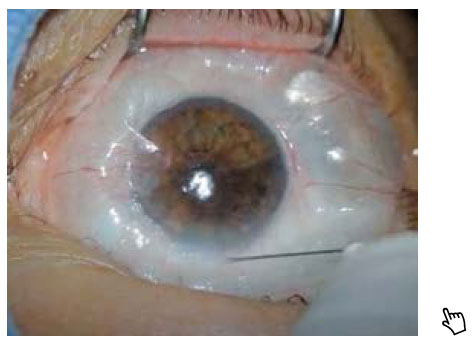
Pterybubble is a novel pneumodissection-assisted technique developed to facilitate pterygium excision. This approach creates a controlled surgical plane through air injection, enabling improved tissue separation while preserving adjacent structures and optimizing preparation of the recipient bed. By enabling atraumatic tissue handling, the technique potentially enhances surgical precision and reduces the manipulation of the ocular surface.
An additional advantage of the Pterybubble technique is that it enables the creation of an exceptionally thin conjunctival graft. Such a graft might contribute to improved postoperative cosmetic outcomes and greater patient comfort. Previous studies have demonstrated that air-assisted graft harvesting techniques can yield thinner conjunctival grafts than conventional manual dissection methods3,4.
Reduced graft thickness facilitates smoother ocular surface reconstruction and potentially decreases the risk of recurrence when combined with conjunctival autografting1,5.
This video manuscript presents the surgical concept, key technical steps, and potential advantages of Pterybubble as an adjunctive innovation in pterygium surgery.
REFERENCES
1. Ang LPK, Chua JLL, Tan DTH. Current concepts and techniques in pterygium treatment. Curr Opin Ophthalmol. 2007;18(4):308-13.
2. Farid M, Pirnazar JR. A comparison of fibrin tissue adhesive to absorbable sutures for conjunctival autograft fixation in pterygium surgery. Cornea. 2009;28(1):43-5.
3. Clearfield E, Hawkins BS, Kuo IC. Conjunctival autograft versus amniotic membrane transplantation for treatment of pterygium: findings from a Cochrane systematic review. Am J Ophthalmol. 2017 Oct;182:8-17.
4. Moscovici BK, Rodrigues PF, Freitas MMS, Silva FB, Felberg S, Dantas PEC. Donor graft harvesting with air in pterygium surgery. Eur J Ophthalmol. 2022;32(5):3103-3109.
5. Moreno CB, Cruz JCG, Soares PVB, Barboza GNC, Barboza LRC, Barboza MNC, et al. Analysis of the thickness of conjunctival autograft in pterygium surgery with the Moscovici dissection technique compared with manual dissection. Rev Bras Oftalmol. 2023;82:e0042.
| AUTHOR INFORMATION |
|
 |
» Leonardo Torquetti https://lattes.cnpq.br/7643491946171288 https://orcid.org/0000-0002-1749-9608 |
 |
» Sandro Coscarelli https://lattes.cnpq.br/2334724198456927 https://orcid.org/0000-0002-0554-2939 |
 |
» Vitor Amorim https://lattes.cnpq.br/3786390385285449 https://orcid.org/0009-0001-8356-5677 |
Funding: No specific financial support was available for this study.
Conflict of interest: None of the authors have any potential conflict of interest to disclose.
Received on:
March 3, 2026.
Accepted on:
April 6, 2026.
 eOftalmo está licenciada com uma Licença Creative Commons Atribuição-NãoComercial 4.0 Internacional.
 © 2026 Todos os Direitos Reservados

 Ler em português
 Português PDF
 Imprimir
 Enviar este artigo por email
 Como citar este artigo
 Enviar um comentário
 Mendeley
 Pocket
 Compartilhar no Facebook
 Compartilhar no Twitter
 Compartilhar no Linkedin
 Compartilhar no WhatsApp