

Izabela Fernandes Godinho1,2; Marcella Pedro Franco de Carvalho1,2; Isabella Cristina Tristão Pinto Resende1,2; Mylene Leal Matsuhara3
DOI: 10.17545/eOftalmo/2026.v12.0010
Este artigo pertence à Edição Especial Da Teoria à Prática: Reabilitação Visual para Oftalmologistas
ABSTRACT
PURPOSE: Low vision is characterized by a significant reduction in visual acuity and/or visual field that persists after refractive correction, clinical treatment, or surgery. In these patients, visual rehabilitation should begin after the best possible optical correction, with contact lenses being an essential resource. This study aimed to describe the role of contact lenses in the visual and functional rehabilitation of patients with low vision and highlight their main indications, benefits, and limitations.
METHODS: This is a narrative review of the application of different contact lens modalities — soft, rigid gas-permeable, and scleral — in relevant low vision clinical contexts.
DISCUSSION: Rigid gas-permeable contact lenses are indicated for diseases associated with high ametropia, anisometropia, and irregular corneas to promote improved optical quality, reduced anisicony, functional widening of the visual field, and greater comfort. Filtering lenses play an important role in managing photosensitivity and improving color discrimination, and provide aesthetic benefits in amaurotic eyes, thus contributing to psychosocial rehabilitation.
CONCLUSION: Contact lenses are an essential tool in the rehabilitation of low vision, offering visual, functional, and aesthetic gains. Adaptation must be individualized and performed by a specialized professional and monitored periodically.
Keywords: Visual rehabilitation; Contact lenses; Low vision; Visual aids; Refractive errors.
RESUMO
OBJETIVO: A visão subnormal caracteriza-se por redução significativa da acuidade visual e/ou do campo visual, persistente mesmo após correção refracional, tratamento clínico ou cirúrgico. Nesses pacientes, a reabilitação visual deve iniciar-se após a melhor correção óptica possível, sendo as lentes de contato um recurso fundamental. O objetivo é descrever o papel das lentes de contato na reabilitação visual e funcional de pacientes com visão subnormal, destacando suas principais indicações, benefícios e limitações.
MÉTODOS: Revisão narrativa da aplicação das diferentes modalidades de lentes de contato — gelatinosas, rígidas gás-permeáveis e esclerais — em contextos clínicos relevantes da visão subnormal.
DISCUSSÃO: As lentes de contato rígidas gás-permeáveis são indicadas para doenças associadas a altas ametropias, anisometropias e córneas irregulares, promovendo melhora da qualidade óptica, redução de aniseiconia, ampliação funcional do campo visual e maior conforto. Já as lentes filtrantes desempenham papel relevante no manejo da fotossensibilidade e na melhora da discriminação cromática, além de benefícios estéticos em olhos amauróticos, contribuindo para a reabilitação psicossocial.
CONCLUSÃO: As lentes de contato constituem ferramenta essencial na reabilitação da visão subnormal, oferecendo ganhos visuais, funcionais e estéticos. A adaptação deve ser individualizada, realizada por profissional especializado e acompanhada periodicamente.
Palavras-chave: Reabilitação visual; Lente de contato; Baixa visão; Auxílios visuais; Erros de refração.
INTRODUCTION
Low vision (moderate and severe visual impairment) is a condition characterized by reduced visual acuity (VA) or visual field (VF) of the patient, even after all forms of correction: refractive, pharmacological, or surgical treatments. A person is considered to have low vision when their best-corrected VA in the better eye is worse than 20/70 (0.30) and equal to or better than 20/400 (0.05), or when the VF in the better eye is equal to or less than 20 degrees from the point of fixation1-3.
Visual rehabilitation should begin after the best possible refractive correction has been made. In this context, contact lenses, in their various forms, are an important tool to help with visual rehabilitation4.
Contact lenses are indicated to improve the quantitative aspects of vision in patients with conditions associated with high ametropia and irregular corneas, as well as qualitative aspects (contrast sensitivity, color vision, adaptation to light) in patients who need management of photosensitivity or help with color discrimination. Other benefits include improved visual comfort in cases of anisometropia, the possibility of combining other optical resources, and the treatment of ocular surface conditions1,4,5.
Finally, considering rehabilitation in a broader context, not only visual, it is extremely important to highlight the role of contact lenses in social rehabilitation through greater aesthetic acceptance by patients with amaurotic eyes, such as phthisis bulbi and extensive leukomas1,4,5.
Indications
Use of contact lenses in high ametropia
Many individuals with low vision have conditions associated with high ametropia. The use of lenses by these patients not only helps correct ametropia but also prevents VF restrictions and minimizes changes in image size (magnification and minification) and the prismatic effect induced by glasses1,6,7.
Patients with high myopia see images with minification due to the use of negative lenses, while patients with high hyperopia see images with magnification due to the use of positive lenses and, consequently, have reduced VF. Because of the shorter distance to the vertex in lenses, compared to glasses, these effects, which can be quite bothersome for patients, are reduced with the use of lenses1,6,7.
In addition, the lenses confer the advantage of eliminating distortions that occur when wearing glasses due to the thickness of the edge of the lenses and the frame's rim, thereby improving spatial perception. Finally, patients gain in comfort, as a result of the elimination of the weight of the lenses, and in the aesthetic aspect1,6,7.
Use of contact lenses in anisometropia
Anisometropia is a condition characterized by a refractive difference between the two eyes. It is classified as axial when the eyes have different axial lengths and as refractional when the eyes have similar axial lengths with refractional differences caused by alterations in the refractive media, such as the cornea and the lens8.
Clinically, they are classified as simple anisometropia (one eye with emmetropia and one eye with ametropia), compound anisometropia (both eyes with different degrees of the same type of ametropia: anisometropic myopia, anisometropic hyperopia, and anisometropic astigmatism), or mixed anisometropia (eyes with different types of ametropia)1,8.
Differences of more than 1.00 diopter can lead to complaints such as1,8:
• Aniseikonia: A visual condition characterized by a difference in the size of the image perceived by the eyes, making proper binocular fusion difficult.
• Asthenopia: A set of symptoms caused by excessive strain on the visual system, including eye pain, headache, burning, tearing, and blurred vision.
• Amblyopia: Reduced VA in one or both eyes without an anatomical cause, due to inadequate visual stimulation during the critical period of visual development in childhood. In this context, wearing contact lenses as early as possible after congenital cataracts, combined with visual stimulation, is important to reduce the risk of developing amblyopia.
In patients with low vision associated with axial anisometropia of more than 3 diopters, especially in cases with high refractive degree, lenses can help reduce aniseikonia while imparting the benefit of improving binocular interaction and consequently reducing asthenopic complaints. These effects might be attributed to the modification of the power of the system that refracts the light. The contact lens sits virtually at zero vertex distance, drastically reducing the effects of magnification or minification. As a result, the images become more similar, promoting binocular vision1,8.
In refractive anisometropia, although the contact lens reduces prismatic effects and improves visual comfort compared to glasses, aniseikonia tends to persist because optical magnification occurs predominantly inside the eye. Therefore, contact lenses can provide partial functional improvement but are often not sufficient to fully restore binocular fusion1,8.
Use of contact lenses in irregular corneas
Patients with corneal irregularities — corneal ectasia or corneal scars — represent a significant challenge in visual rehabilitation. In this context, rigid gas-permeable (RGP) contact lenses play an important role because they neutralize these irregularities. This neutralization of the corneal surface occurs through the formation of a regular tear lens between the lens and the cornea, resulting in a gain in optical quality, even in cases with low vision1,4,9.
Combination with other optical resources
Contact lenses offer the advantage of facilitating the simultaneous use of other optical resources, such as telescopic systems, microscopic lenses, and spheroprismatic lenses1.
Treatment of ocular surface conditions
Ocular surface conditions are multifactorial and are characterized by ocular discomfort, tear film instability, changes in osmolarity, and inflammatory reactions. Although conventional treatments such as lubricating eye drops, corticosteroids, and tear plugs are available, these options often do not completely resolve patients' symptoms. In this context, contact lenses can be used as a viable therapeutic option to treat these disorders4,10.
In addition, contact lenses moisturize and protect the ocular surface, offering protection against mechanical trauma and serving as a vehicle for the continuous release of medication4,10.
Soft lenses are used to relieve pain in superficial lesions, help promote epithelial healing in persistent defects, and provide comfort after surgery, such as refractive surgery4,10.
RGP scleral lenses should be considered as a therapeutic option for patients with low vision associated with ocular surface conditions that are refractory to conventional treatment. These lenses create a fluid reservoir between the lens and the cornea and thus continuously protect and lubricate the cornea, improving the symptoms of severe dry eye. In addition, they serve as support for uneven surfaces in conditions such as Stevens–Johnson Syndrome4,10.
Management of photosensitivity
Soft contact lenses can be used to manage disabling photosensitivity. In these cases, medical filter lenses are indicated, which have the pigment distributed homogeneously, including the pupillary area. In cases of severe photophobia, the adaptation is usually binocular, aiming for light symmetry and greater comfort. The recommended shades are brown with an amber (Figure 1) or red pupil (Figure 2), depending on the need for spectral filtering and functional preferences. Conditions that can benefit from their use include achromatopsia, cone dystrophy, and Stargardt's disease11-13.
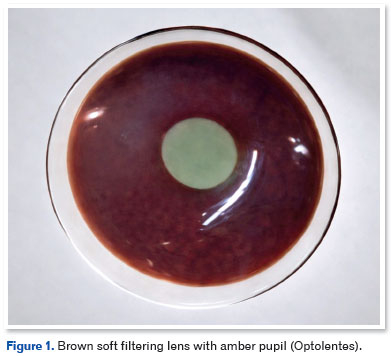
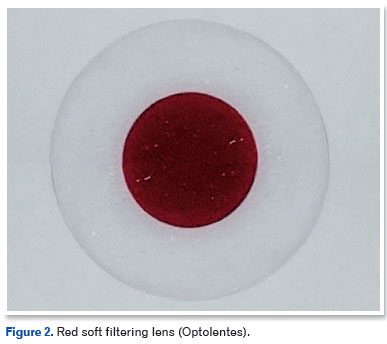
The red shade helps improve photophobia because red has a longer wavelength and lower frequency, leading to less instability in the visual pigment of the rods when exposed to light. Notably, unlike filter lenses, conventional cosmetic lenses have a transparent pupil and do not offer adequate light protection or effective spectral modulation11-13.
Assistance in color discrimination
Filtering soft contact lenses can also be used to improve color discrimination in patients with red-green axis dyschromatopsia, popularly known as color blindness11-17.
The aim of using absorptive or filtering lenses is to reduce the intensity of light radiation reaching the eyes, offering comfort and protection. In addition, these lenses increase contrast, reduce glare, and improve color perception11-17.
For patients with red-green axis dyschromatopsia, fitting is usually monocular (in the non-dominant eye), though it can be binocular in selected cases. In these patients, a red lens is recommended (Figure 2), and comparative chromatic discrimination tests should be performed, such as Ishihara or D-15, before and during the use of the filtering lens to document the functional response11-17.
As with any practice involving contact lenses, the fitting of soft filtering lenses is a medical act. It should be preceded by a complete ophthalmologic examination and followed up regularly to ensure safety, comfort, and ongoing therapeutic efficacy. Furthermore, properly explaining the benefits and limitations to the patient reduces unrealistic expectations and contributes decisively to successful adaptation11-17.
Cosmetic use
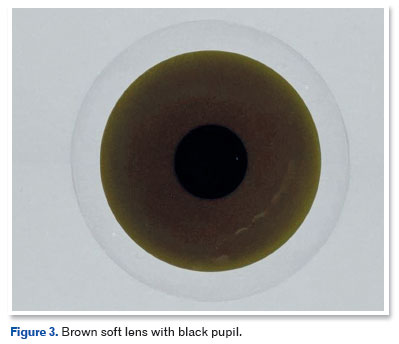
Soft contact lenses can be used to improve the appearance of amaurotic eyes with leukocoria. In these cases, aesthetic rehabilitation should be sought by prioritizing, in pigmented soft lenses, the correspondence with the shade of the contralateral eye. The use of a black-pigmented pupil is recommended to prevent translucency from revealing the appearance of residual leukocoria, which is potentially noticeable to the observer (Figure 3)11,18.
In conclusion, the use of contact lenses in patients with low vision is an effective visual rehabilitation strategy that provides significant gains in VA, VF, and functional comfort. The different types of lenses available on the market allow for individualized adaptation, considering the anatomical and refractive characteristics of each patient. In addition to improving VA, contact lenses reduce corneal aberrations and optimize the quality of vision in daily activities, contributing to the quality of life of these individuals.
Adaptation requires specialized professional follow-up and constant monitoring to minimize the risk of ocular complications and ensure therapeutic efficacy. Therefore, contact lenses are a valuable tool in the visual rehabilitation of patients with low vision as they provide personalized solutions that often overcome the limitations of conventional glasses.
REFERENCES
1. Conselho Brasileiro de Oftalmologia. Refratometria e visão subnormal. São Paulo: Conexão Propaganda e Editora; 2023. 361 p. (Série Oftalmologia CBO; 9).
2. World Health Organization. International statistical classification of diseases and related health problems: ICD-10. 10th rev. 5th ed. Geneva: World Health Organization; 2016. 3 vols.
3. World Health Organization. International classification of diseases for mortality and morbidity statistics: ICD-11. 11th rev. Geneva: World Health Organization; 2022.
4. Conselho Brasileiro de Oftalmologia. Lentes de contato. São Paulo: Conexão Propaganda e Editora; 2023. 239 p. (Série Oftalmologia CBO; 10).
5. American Academy of Ophthalmology. Vision rehabilitation preferred practice pattern. San Francisco: American Academy of Ophthalmology; 2022.
6. McLean IR, Erkelens IM, Sherbak EF, Mikkelsen LT, Sharma R, Cooper EA. The contribution of image minification to discomfort experienced in wearable optics. J Vis. 2023;23(8):10.
7. Farahmand AW, Jafari MH, Niazi N. A comparative analysis between contact lenses and eyeglasses. Int J Innov Sci Res Technol. 2025;10(8):708–712.
8. Faria e Sousa SJ. Revisando as anisometropias. Arq Bras Oftalmol. São Paulo: 2002;65(1):114-117.
9. Lim L, Lim EWL. Current perspectives in the management of keratoconus with contact lenses. Eye (Lond). 2020;34(12):2175–2196.
10. Chaudhary S, Ghimire D, Basu S, Agrawal V, Jacobs DS, Shanbhag SS. Contact lenses in dry eye disease and associated ocular surface disorders. Indian J Ophthalmol. 2023;71(4):1142–1153.
11. Matsuhara ML. Adaptação de lentes de contato em visão subnormal. In: Godinho C, Dantas B, Sobrinho M, Polisuk P. O padrão CG em lentes de contato. 2 ed. Rio de Janeiro: Guanabara Koogan; 2009. 440 p.
12. Katz BJ, Digre KB. Diagnosis, pathophysiology, and treatment of photophobia. Surv Ophthalmol. 2016;61(4):466-77.
13. Park WL, Sunness JS. Red contact lenses for alleviation of photophobia in patients with cone disorders. Am J Ophthalmol. 2004;137(4):774-5.
14. Hiraoka T, Ishii Y, Okamoto F, Oshika T. Influence of cosmetically tinted soft contact lenses on higher-order wavefront aberrations and visual performance. Graefes Arch Clin Exp Ophthalmol. 2009;247(2):225-33.
15. Sei M. Estudo da Sensibilidade ao Contraste, do Glare e do Campo Visual na Baixa Visão. In: Sampaio MW, Haddad MAO, Costa Filho HA, Siaulys MOC. Baixa Visão e Cegueira - Os Caminhos para a Reabilitação, a Educação e a Inclusão. 1 ed. Rio de Janeiro: Cultura Médica / Guanabara Koogan; 2009
16. Schornack MM, Brown WL, Siemsen DW. The use of tinted contact lenses in the management of achromatopsia. Optometry. 2007;78(1):17-22.
17. Fernandes LC, Urbano LCV. Lentes de contato filtrantes coloridas nas discromatopsias: relato de casos. Arq. Bras. Oftalmol. 2003;66(3):381-384.
18. Mutilab HA, Sharanjeet-Kaur, Keu LK, Choo PF. Special tinted contact lens on colour-defects. Clin Ter. 2012;163(3):199-204.
| AUTHOR'S INFORMATION |
|
 |
» Izabela Fernandes Godinho http://lattes.cnpq.br/5257249884460383 https://orcid.org/0000-0001-8556-5462 |
 |
» Marcella Pedro Franco de Carvalho http://lattes.cnpq.br/5784419476497700 https://orcid.org/0000-0001-7924-6350 |
 |
» Isabella Cristina Tristão Pinto Resende http://lattes.cnpq.br/8527563721330651 https://orcid.org/0000-0001-6552-7557 |
 |
» Mylene Leal Matsuhara http://lattes.cnpq.br/4812084763817308 https://orcid.org/0000-0002-3539-3444 |
Funding: The authors declare no funding.
Conflicts of interest: The authors declare no funding.
Received on:
January 22, 2026.
Accepted on:
March 30, 2026.
 eOftalmo está licenciada com uma Licença Creative Commons Atribuição-NãoComercial 4.0 Internacional.
 © 2026 Todos os Direitos Reservados


 Ler em português
 Português PDF
 Imprimir
 Enviar este artigo por email
 Como citar este artigo
 Enviar um comentário
 Mendeley
 Pocket
 Compartilhar no Facebook
 Compartilhar no Twitter
 Compartilhar no Linkedin
 Compartilhar no WhatsApp