

Anna Paula Amaral Nassaralla; Fernando Renato Praes Calixto; Leandra Amarante Rodrigues Ferreira; Emílio Rintaro Suzuki Júnior
DOI: 10.17545/eOftalmo/2026.v12.0021
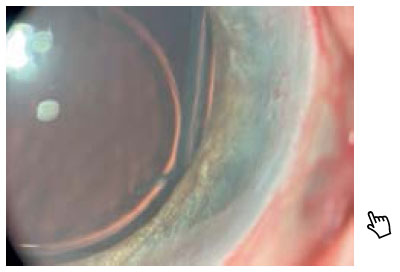
A 68-year-old female presented with recurrent subluxation of an intraocular lens (IOL) in the left eye, without a history of ocular trauma and initially with normal intraocular pressure (IOP). Owing to insufficient capsular support, scleral fixation using the Yamane technique was performed. However, the postoperative course was complicated by repeated episodes of IOL decentration, ultimately necessitating pars plana vitrectomy and secondary IOL reimplantation.
Such complications after intrascleral fixation have previously been reported, including IOL tilt and optic–haptic distortion1. Comparative studies show that although the Yamane technique generally yields good functional outcomes, late-onset instability may occur in a subset of patients2.
Several months after the secondary IOL implantation, the patient developed medically uncontrolled IOP, a complication associated with scleral-fixated IOLs2, and pars plana Ahmed tube implantation was indicated.
Secondary IOL implantation is typically recommended when capsular support is inadequate or lens displacement occurs, while the Ahmed valve remains a well-established option for managing refractory glaucoma by facilitating an alternative aqueous outflow pathway. In vitrectomized eyes or in cases involving unstable IOLs, pars plana tube placement offers distinct advantages, including a reduced risk of corneal complications related to anterior chamber placement4,5.
In the present case, pars plana Ahmed valve implantation not only achieved effective IOP control but also provided additional mechanical support to the IOL. This ancillary stabilizing effect contributed to improved IOL centralization and resulted in a marked refractive improvement.
REFERENCES
1. Safran JP, Safran SG. Intraocular lens tilt due to optic-haptic junction distortion following intrascleral haptic fixation with the Yamane technique. Am J Ophthalmol Case Rep. 2023 Apr 13:30:101845.
2. Guerin PL, Guerin GM, Pastore MR, Gouigoux S, Tognetto D. Long-term functional outcome between Yamane technique and retropupillary iris-claw technique in a large study cohort. J Cataract Refract Surg. 2024;50(6):605-10.
3. Srivastava S, Bhawesh K, Rohatgi J, Gupta VP. Secondary Glaucoma after Scleral fixation of PC-IOLs (SF-IOLs). Eur J Cardiovasc Med. 2025 Jun;15(6):256–258. doi:10.5083/ejcm/25-06-48
4. Kumar H, Thulasidas M. Pars plana implantation of glaucoma drainage devices - The way to succeed in refractory glaucoma. Indian J Ophthalmol. 2021;69(7):1650-1651.
5. De Frutos-Lezaun M, Rodriguez-Agirretxe I, Labairu FE, Irigoyen C. Vitrectomy combined with posterior-segment Ahmed valve implant: A case series study. Saudi J Ophthalmol. 2018;32(3):180-7.
| AUTHOR'S INFORMATION |
|
 |
» Anna Paula Amaral Nassaralla https://orcid.org/0000-0001-5964-8176 http://lattes.cnpq.br/0838298753024106 |
 |
» Fernando Renato Praes Calixto https://orcid.org/0009-0002-7439-0825 http://lattes.cnpq.br/5257726952186975 |
 |
» Leandra Amarante Rodrigues Ferreira https://orcid.org/0009-0009-8392-3110 http://lattes.cnpq.br/5825441268903652 |
 |
» Emílio Rintaro Suzuki Júnior https://orcid.org/0000-0001-8437-6686 http://lattes.cnpq.br/0193399400009676 |
Funding: No specific financial support was available for this study.
Conflict of interest: None of the authors have any potential conflict of interest to disclose.
Received on:
December 4, 2025.
Accepted on:
February 9, 2026.
 eOftalmo está licenciada com uma Licença Creative Commons Atribuição-NãoComercial 4.0 Internacional.
 © 2026 Todos os Direitos Reservados


 Ler em português
 Português PDF
 Imprimir
 Enviar este artigo por email
 Como citar este artigo
 Enviar um comentário
 Mendeley
 Pocket
 Compartilhar no Facebook
 Compartilhar no Twitter
 Compartilhar no Linkedin
 Compartilhar no WhatsApp