

Tiago Santos Prata1; Caroline Klein Diniz2; Ana Carolina Hatsuia Ferreira3
DOI: 10.17545/eOftalmo/2026.v12.0016
Este artigo pertence à Edição Especial Edição Especial de Glaucoma
ABSTRACT
Selective laser trabeculoplasty and minimally invasive glaucoma surgery should be considered as complementary strategies in the contemporary management of glaucoma, rather than competing modalities. Selective laser trabeculoplasty has good safety, reproducibility, repeatability, and outpatient applicability profile, with robust evidence of efficacy and impact on reducing dependence on eye drops, particularly in patients with ocular hypertension or mild-to-moderate primary open-angle glaucoma. Minimally invasive glaucoma surgery has a more defined role in patients with concomitant indications for cataract surgery, because it offers additional benefits of reducing intraocular pressure and medication burden. In resource-limited settings, particularly in public health systems, selective laser trabeculoplasty stands out as a sustainable option that simplifies treatment, improves adherence, reduces adverse effects of chronic topical therapy, and potentially optimizes future outcomes. The rational incorporation of selective laser trabeculoplasty requires professional training, increased access to technology, appropriate reimbursement models, and strategies for early diagnosis. In this context, tools such as retinography combined with artificial intelligence can help identify patients in the early stages of the disease, thus favoring more timely, cost-effective, and patient-centered interventions.
Keywords: Selective laser trabeculoplasty; Primary open-angle glaucoma; Minimally invasive glaucoma surgery; Cost-effectiveness; Early diagnosis.
RESUMO
A trabeculoplastia seletiva a laser e as cirurgias minimamente invasivas para glaucoma devem ser compreendidas como estratégias complementares no manejo contemporâneo do glaucoma, e não como modalidades concorrentes. A trabeculoplastia seletiva a laser apresenta perfil favorável de segurança, reprodutibilidade, possibilidade de repetição e aplicabilidade ambulatorial, com evidências robustas de eficácia e impacto na redução da dependência de colírios, especialmente em pacientes com hipertensão ocular ou glaucoma primário de ângulo aberto leve a moderado. As cirurgias minimamente invasivas para glaucoma, por sua vez, têm papel mais definido em pacientes com indicação concomitante de cirurgia de catarata, nos quais podem oferecer benefício adicional na redução da pressão intraocular e da carga medicamentosa. Em cenários de restrição econômica, particularmente em sistemas públicos de saúde, a trabeculoplastia seletiva a laser destaca-se como uma alternativa sustentável, capaz de simplificar o tratamento, melhorar a adesão, reduzir efeitos adversos da terapia tópica crônica e potencialmente otimizar desfechos futuros. A incorporação racional da trabeculoplastia seletiva a laser exige capacitação profissional, ampliação do acesso à tecnologia, modelos adequados de remuneração e estratégias de diagnóstico precoce. Nesse contexto, ferramentas como a retinografia associada à inteligência artificial podem contribuir para identificar pacientes em fases iniciais, favorecendo intervenções mais oportunas, custo-efetivas e centradas no paciente.
Palavras-chave: Trabeculoplastia seletiva a laser; Glaucoma primário de ângulo aberto; Cirurgias minimamente invasivas para glaucoma; Custo-efetividade; Diagnóstico precoce.
The integration of new technologies into glaucoma management has led to a significant increase in treatment options in clinical practice, particularly with the advent of minimally invasive glaucoma surgery (MIGS). In this scenario, it is essential to compare these approaches and also understand how to rationally integrate them throughout the course of the disease.
Selective laser trabeculoplasty (SLT) has fundamentally different characteristics from MIGS. It is a non-invasive, time-efficient procedure with high technical reproducibility and an excellent safety profile and can be performed in an outpatient setting, without the need for an operating room. Moreover, SLT is the modality with the largest body of evidence from long-term follow-up, including data on its impact on reducing intraocular pressure (IOP) and the number of medications used and its impact on disease progression1-3.
In terms of efficacy, comparative studies show that the pressure reduction obtained with SLT is similar to that obtained with some MIGS techniques, both with and without implantable devices. Procedures such as implantation of trabecular stents (e.g., iStent) or ab interno goniotomy techniques (such as those performed with specialized blades, including the Kahook Dual Blade) achieve, on average, IOP reductions in the range of 20%–30%, which are similar to those obtained with SLT in different populations4-6. However, SLT has a significant additional advantage relative to MIGS: the possibility of repetition while maintaining satisfactory levels of efficacy and safety, as demonstrated in multiple clinical studies7,8. These characteristics make SLT a particularly strategic option as initial treatment.
Based on this evidence, an integrated and stepwise approach is proposed. In patients with ocular hypertension or mild-to-moderate primary open-angle glaucoma (POAG), particularly in phakic eyes without cataracts or in eyes already pseudophakic, SLT should be considered a first-line treatment, as shown by randomized studies demonstrating efficacy comparable to drug treatment, and a reduced need for eye drops2. However, MIGS plays a defined role in a specific context: patients with an indication for cataract surgery, for whom the association with a minimally invasive procedure provides additional benefit in reducing IOP and medication burden while also having an impact on disease control5,6.
From this perspective, the integration of SLT and MIGS should be understood as a logical continuum along the natural history of glaucoma, rather than an exclusive choice between modalities. In practical terms, it does not seem justifiable to recommend a surgical approach, even a minimally invasive surgery, in patients who require moderate pressure reductions (in the range of 20%–25%) or a reduction in medication, particularly when there is no concomitant indication for phacectomy. In these cases, SLT offers equivalent efficacy, minimal invasiveness, lower cost, and higher technical simplicity.
This logic of stepwise treatment, starting with SLT and reserving MIGS for specific scenarios, particularly when combined with cataract surgery, allows for a more rational, cost-effective, and patient-centered approach, aligning with both the available scientific evidence and current clinical practice (Figure 1).
Role of SLT in Resource-Limited Settings
In addition to traditional economic analyses, it is important to recognize that the advantages of SLT in resource-limited settings extend beyond direct costs, encompassing its clinical benefits and long-term impact on glaucoma progression. Unlike topical medical treatment, which acts predominantly to reduce aqueous humor production or increased uveoscleral outflow, SLT acts directly on trabeculopathy, the main pathophysiological mechanism of POAG. By modulating the function of the trabecular meshwork, SLT not only reduces IOP but also intervenes more directly at the site of resistance to aqueous humor outflow9,10.
This difference in approach has relevant clinical implications. Although the initial pressure reduction obtained with SLT and antiglaucoma eye drops is often similar, laser treatment is associated with less need for escalation over time. Data from the LiGHT Trial show that approximately 70% of patients initially treated with SLT remained medication-free after six years of follow-up, with less than half requiring re-treatment during this period11,12. The data also show that patients initially treated with SLT were less likely to need antiglaucoma surgery over time, when compared to those who started treatment with medication11.
This contrasts with patients initially treated with eye drops, in whom there is a progressive tendency to add multiple medications to maintain ocular pressure control. This escalation leads to higher cumulative costs and significantly affects treatment adherence, a recognized kind of challenge in glaucoma management13. Adherence challenges are particularly relevant in public healthcare systems, where combination formulations are often unavailable, resulting in a higher number of daily instillations. This increase in therapeutic complexity is directly associated with poorer disease control and higher risk of progression.
In addition, there is evidence that for similar levels of mean IOP throughout follow-up, patients initially treated with SLT show less functional progression than those treated exclusively with medications11. This finding suggests that the greater pressure stability (lower IOP variability) associated with SLT may play a relevant role in protecting the optic nerve.
Another aspect that is often overlooked is the iatrogenic impact of chronic topical treatment on the ocular surface and quality of life. Prolonged use of multiple medications, often containing preservatives, is associated with inflammation of the ocular surface, discomfort, reduced visual quality, and poorer adherence to treatment14.
Finally, it is important to consider the impact of initial treatment on future surgical outcomes. The literature shows that prolonged use of multiple topical medications is associated with greater conjunctival inflammation and poorer performance in filtering surgeries, such as trabeculectomy, increasing the risk of surgical failure15. In this context, strategies that reduce chronic exposure to eye drops, such as SLT, may contribute to better outcomes in patients who may eventually require surgical intervention.
Thus, when considering the role of SLT in public health systems, especially in resource-limited settings, it becomes clear that its benefits extend beyond the reduction of direct costs. SLT strategically combines pathophysiological intervention, therapeutic simplification, improved adherence, preservation of quality of life, and potential optimization of long-term outcomes, making it one of the most complete and sustainable approaches for glaucoma management.
Final Thoughts and Future Directions
In recent years, the discussion of SLT has moved beyond comparisons of therapeutic modalities and now plays a broader role in organizing glaucoma care. More than a cost-effective therapeutic alternative, SLT should be understood as a technology that combines fundamental characteristics for scalability, namely safety, reproducibility, ease of use, and large-scale applicability.
From a safety point of view, SLT has an extremely favorable profile. Population-based studies show that the incidence of serious, potentially sight-threatening complications is exceptionally low, at around 1 in 6,000 procedures, which reinforces its role as a low-risk intervention even when used on a large scale16. In addition, the possibility of repeating the procedure while maintaining efficacy makes it even more attractive over the course of the disease.
However, it is essential to recognize that the cost-effectiveness and clinical impact of SLT are directly related to the timing of its indication. The literature consistently shows that laser treatment yields better results in patients with ocular hypertension and early-to-moderate POAG, in whom target IOP levels are more compatible with the magnitude of reduction achieved by the procedure11,17. In more advanced stages, in which more aggressive pressure reductions are required, SLT tends to play a more limited role, which reduces its suitability as a stand-alone strategy.
From this perspective, SLT appears to be more efficient as an initial therapy than as a late adjuvant intervention, especially when considered within cost-effectiveness models. This observation reinforces the need for a reappraisal of glaucoma management that is not only technical but also structural. For this model to become a reality, particularly in the Brazilian context, some strategic pillars need to be considered.
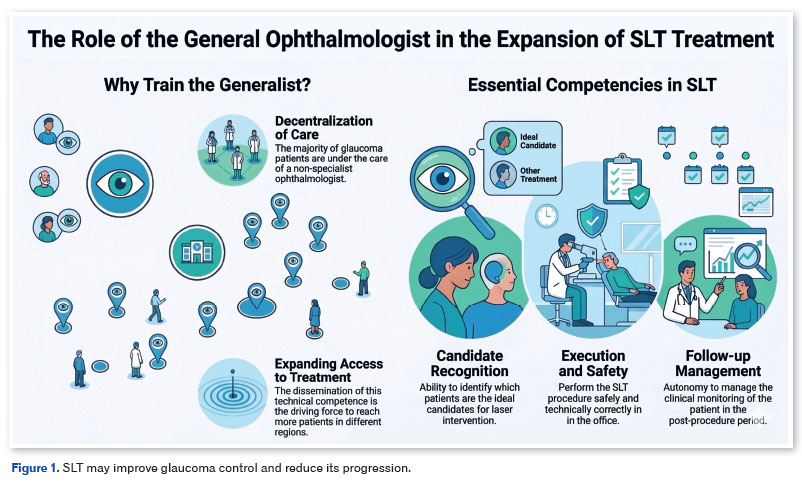
The first is training general ophthalmologists. The majority of patients with glaucoma are not seen at specialized centers but rather by general ophthalmologists who are not glaucoma specialists. It is therefore essential that non-specialist physicians be able to identify ideal candidates, appropriately indicate and safely perform SLT, and manage post-procedure follow-up. The dissemination of this expertise is fundamental to expanding access to treatment (Figure 2).
The second pillar is the availability of technology. Access to laser technology should be expanded in both the private healthcare sector and, especially, the public healthcare system. For this to be achieved, economic incentives and reimbursement models must be aligned to make the procedure both viable and attractive for healthcare providers, correcting current distortions that still favor chronic medical therapy.
The third pillar, and perhaps vital, is early detection of the disease. Glaucoma remains a condition characterized by missed opportunities for diagnosis. Many patients are diagnosed late owing to a lack of access to an ophthalmologist and limitations in disease detection during routine consultations.
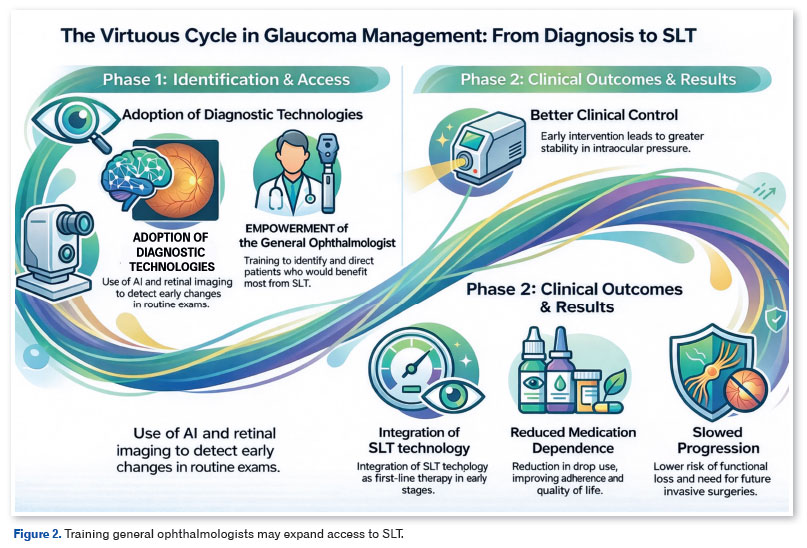
In this context, the incorporation of more objective and accessible diagnostic tools may play a transformative role. Technologies such as retinography combined with artificial intelligence algorithms have already been demonstrated to assist in the early detection of glaucomatous changes, with potential for large-scale application and relatively low cost18,19. Encouraging the adoption of these tools in the general ophthalmologist practice may substantially improve the identification of patients in the early stages, precisely those who benefit most from SLT. Thus, an integrated and virtuous model is established: earlier diagnosis, broader access to laser treatment, and intervention at earlier stages of the disease, resulting in better clinical control, reduced dependence on medication, and a potential decrease in glaucoma progression.
In this context, Brazil has a unique opportunity. The convergence of a comprehensive public healthcare system, a skilled ophthalmology community, and the growing availability of cost-effective technologies creates a favorable environment for implementing innovative models of care. By prioritizing evidence-based strategies focused on early intervention and rational use of resources, the country can improve public ocular health outcomes and position itself as an international reference in the implementation of sustainable technologies for glaucoma care.
REFERENCES
1. Latina MA, Park C. Selective targeting of trabecular meshwork cells: in vitro studies of pulsed and continuous wave laser interactions. Exp Eye Res. 1995;60(4):359-71.
2. Garg A, Gazzard G. Selective laser trabeculoplasty: past, present, and future. Eye (Lond). 2018;32(5):863-876.
3. Gazzard G, Konstantakopoulou E, Garway-Heath D, Garg A, Vickerstaff V, Hunter R, Ambler G, Bunce C, Wormald R, Nathwani N, Barton K, Rubin G, Buszewicz M; LiGHT Trial Study Group. Selective laser trabeculoplasty versus eye drops for first-line treatment of ocular hypertension and glaucoma (LiGHT): a multicentre randomised controlled trial. Lancet. 2019;393(10180):1505-1516.
4. Katz LJ, Steinmann WC, Kabir A, Molineaux J, Wizov SS, Marcellino G; SLT/Med Study Group. Selective laser trabeculoplasty versus medical therapy as initial treatment of glaucoma: a prospective, randomized trial. J Glaucoma. 2012;21(7):460-8.
5. Samuelson TW, Katz LJ, Wells JM, Duh YJ, Giamporcaro JE; US iStent Study Group. Randomized evaluation of the trabecular micro-bypass stent with phacoemulsification in patients with glaucoma and cataract. Ophthalmology. 2011;118(3):459-67.
6. Dorairaj SK, Seibold LK, Radcliffe NM, Are AA, Jimenez-Román J, Lascano-Gomez G, et al. 12-Month Outcomes of Goniotomy Performed Using the Kahook Dual Blade Combined with Cataract Surgery in Eyes with Medically Treated Glaucoma. Adv Ther. 2018 Sep;35(9):1460-1469
7. Hong BK, Winer JC, Martone JF, Wand M, Altman B, Shields MB. Repeat selective laser trabeculoplasty. J Glaucoma. 2009; 18(3):180-3.
8. Avery N, Ang GS, Nicholas S, Wells A. Repeatability of primary selective laser trabeculoplasty in patients with primary open-angle glaucoma. Int Ophthalmol. 2013;33(5):501-6.
9. Seider MI, Keenan JD, Han Y. Cost of selective laser trabeculoplasty vs topical medications for glaucoma. Arch Ophthalmol. 2012; 130(4):529-30.
10. Berdahl JP, Khatana AK, Katz LJ, Herndon L, Layton AJ, Yu TM, et al. Cost-comparison of two trabecular micro-bypass stents versus selective laser trabeculoplasty or medications only for intraocular pressure control for patients with open-angle glaucoma. J Med Econ. 2017;20(7):760-766.
11. Gazzard G, Konstantakopoulou E, Garway-Heath D, Adeleke M, Vickerstaff V, Ambler G, Hunter R, Bunce C, Nathwani N, Barton K; LiGHT Trial Study Group. Laser in Glaucoma and Ocular Hypertension (LiGHT) Trial: Six-Year Results of Primary Selective Laser Trabeculoplasty versus Eye Drops for the Treatment of Glaucoma and Ocular Hypertension. Ophthalmology. 2023; 130(2):139-151.
12. Barbosa LEO, Barboza WL, Guedes RAP, Chaoubah A, Hatanaka M. Cost-effectiveness of selective laser trabeculoplasty as a replacement for hypotensive eye drops in the Brazilian public health system. Clinics (Sao Paulo). 2025 Apr 23;80:100650.
13. Olthoff CMG, Schouten JSAG, van de Borne BW, Webers CAB. Noncompliance with ocular hypotensive treatment in patients with glaucoma or ocular hypertension: an evidence-based review. Ophthalmology. 2005;112(6):953-61.
14. Kolko M, Gazzard G, Baudouin C, Beier S, Brignole-Baudouin F, Cvenkel B, et al. Impact of glaucoma medications on the ocular surface and how ocular surface disease can influence glaucoma treatment. Ocul Surf. 2023 Jul;29:456-468.
15. Ojanen ES, Turunen JA, Harju M. The incidence of serious complications after selective laser trabeculoplasty. Acta Ophthalmol. 2026;104(1):106-113.
16. Broadway D, Grierson I, Hitchings R. Adverse effects of topical antiglaucomatous medications on the conjunctiva. Br J Ophthalmol. 1993;77(9):590-6.
17. Kuley B, Zheng CX, Zhang QE, Hamershock RA, Lin MM, Moster SJ, et al. Predictors of Success in Selective Laser Trabeculoplasty. Ophthalmol Glaucoma. 2020;3(2):97-102.
18. Ting DSW, Pasquale LR, Peng L, Campbell JP, Lee AY, Raman R, et al. Artificial intelligence and deep learning in ophthalmology. Br J Ophthalmol. 2019;103(2):167-175.
19. Samico GA, da Costa DR, Scherer R, Azizi A, Rabinowitz AS, Malek DA, et al. Deep Learning-Predicted RNFL Loss and Incident Glaucoma in the Canadian Longitudinal Study on Aging. Ophthalmol Glaucoma. 2026 Mar 19:S2589-4196(26)00051-7.
| AUTHOR'S INFORMATION |
|
 |
» Tiago Santos Prata http://orcid.org/0000-0003-1830-3766 http://lattes.cnpq.br/4375022069702250 |
 |
» Caroline Klein Diniz http://orcid.org/0000-0002-8891-0054 http://lattes.cnpq.br/2897684039140597 |
 |
» Ana Carolina Hatsuia Ferreira http://orcid.org/0009-0000-3015-9301 http://lattes.cnpq.br/5311610239125115 |
Funding: No specific financial support was available for this study.
Conflict of interest: None of the authors have any potential conflict of interest to disclose.
Received on:
April 17, 2026.
Accepted on:
April 29, 2026.
 eOftalmo está licenciada com uma Licença Creative Commons Atribuição-NãoComercial 4.0 Internacional.
 © 2026 Todos os Direitos Reservados


 Ler em português
 Português PDF
 Imprimir
 Enviar este artigo por email
 Como citar este artigo
 Enviar um comentário
 Mendeley
 Pocket
 Compartilhar no Facebook
 Compartilhar no Twitter
 Compartilhar no Linkedin
 Compartilhar no WhatsApp