

Carolina C. Valente1; Gustavo R. Gameiro2; Zelia M. Correa3
DOI: 10.17545/eOftalmo/2026.v12.0015
The early discovery that biallelic inactivation of Retinoblastoma Gene (RB1) can initiate tumor formation established one of the foundational concepts of modern cancer genetics and placed retinoblastoma (RB) in the spotlight of cancer biology1. The disease provided the experimental foundation for the tumor-suppressor gene concept and contributed substantially to the formulation of Knudson's two-hit hypothesis. In germline cases, tumorigenesis begins with functional loss of both alleles of RB1, which encodes the retinoblastoma protein (pRB), a central regulator of cell-cycle progression and transcription2.
A small subset of (less than 10%) RBs are characterized by MYCN amplification that may arise without the canonical biallelic inactivation of RB13. MYCN is a transcription factor that regulates a broad network of genes involved in: cell-cycle progression, ribosome and protein synthesis, cellular metabolism, growth, differentiation, and apoptosis. Recent methylation and transcriptomic studies have identified a MYCN-driven molecular subgroup characterized by DNA hypomethylation. This finding suggests that MYCN could be associated with a broader transcriptional and epigenetic state that promotes dedifferentiation.(3) Importantly, MYCN-driven biology is not restricted to RB1-proficient tumors. MYCN amplification tends to occur in very young children and are frequently unilateral and clinically aggressive4.
Modern literature still supports the loss of both alleles of RB1 to be the key event in RB, and while we are not abandoning Knudson's model; the new evidence showing other epigenetic events may contribute to progression and phenotypical behavior of this neoplasm drives science to factor in that other epigenetic events are part of this story2. Whole-genome studies have demonstrated that some RBs contain remarkably few additional recurrent coding alterations after RB1 inactivation suggesting that epigenetic deregulation can provide critical mechanisms contributing to tumorigenesis5,6.
Epigenetics is particularly relevant in RB because pRB is itself an important regulator of chromatin biology. Beyond its canonical interaction with E2F transcription factors, pRB participates in chromatin regulation through interactions with proteins involved in nucleosome organization, histone modification, DNA methylation, and non-coding RNA networks. Loss of pRB can be viewed not simply as the removal of a cell-cycle checkpoint but as an event capable of reorganizing the transcriptional and chromatin landscape of the developing retinal cell7.
The emerging epigenetic model is not a replacement of the two-hit hypothesis but an extension of it because RB1 loss may create a permissive state that activates oncogenic pathways, and silence tumor-suppressive programs.
DNA methylation is among the best characterized epigenetic abnormalities in RB and MYCN is involved in this process. Epigenetic silencing of RB1 itself was demonstrated as early as 1989, when hypermethylation of the 5' region of the gene was identified in a sporadic unilateral RB8.
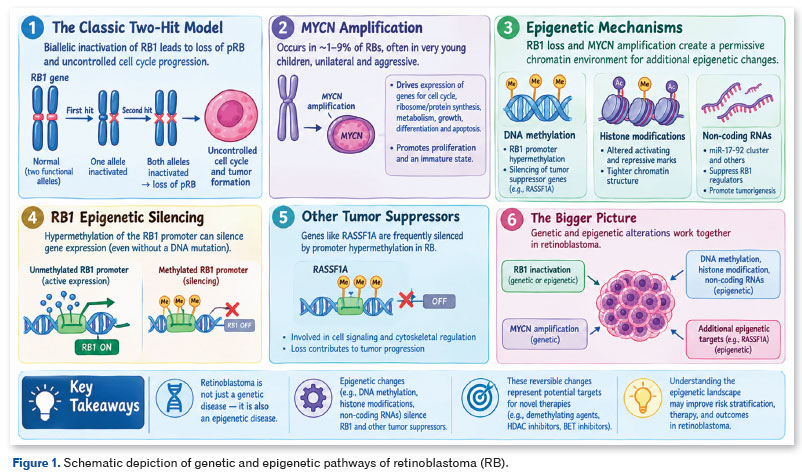
Subsequent studies established that methylation of the RB1 promoter represents a mechanism of RB1 inactivation in a subset of tumors, particularly unilateral sporadic disease. This finding was an early demonstration that epigenetic silencing can contribute to RB1 inactivation, expanding the molecular mechanisms through which RB1 function may be lost9.
The methylome of RB extends well beyond RB1. RASSF1A acts as a crucial tumor suppressor gene involved in cellular signaling and cytoskeletal regulation. RASSF1A promoter hypermethylation has been reported in approximately 59%–82% of retinoblastomas across different studies10. Treatment of RB cell lines with the DNA-demethylating agent 5-aza-2'-deoxycytidine restored RASSF1A expression, providing experimental evidence linking methylation with transcriptional silencing10.
Similarly, methylation of MGMT, a DNA-repair gene, has been reported in a subset of RBs. Although these observations are biologically compelling, differences in sample size, methodology, tumor composition, and historical staging systems have produced variable methylation frequencies across studies. Consequently, individual methylation markers should not yet be regarded as universally validated clinical biomarkers7,10.
Histone modifications and chromatin remodeling determine the accessibility of regulatory DNA and therefore influence whether genes are transcriptionally active or repressed. Loss of pRB is relevant in this context because pRB interacts with multiple chromatin-associated proteins and contributes to transcriptionally repressive chromatin conditions impacting proliferation, differentiation, apoptosis, and cellular identity7.
Integrative genomic and epigenomic analysis identified increased SYK expression in RB despite the absence of recurrent genetic alterations in the gene. Functional experiments demonstrated that SYK contributed to tumor-cell survival5. Epigenomic analysis can reveal cancer-driving pathways activated through altered chromatin states.
Non-coding RNAs add another layer of regulatory complexity to RB biology. MicroRNAs, long non-coding RNAs, and circular RNAs can modulate transcription, mRNA stability, translation, chromatin organization, and signaling pathways, potentially contributing to the phenotypic consequences of RB1 loss11.
It seems the relationship between RB1 and epigenetics is a central feature of RB biology. The conventional interpretation is that RB1 loss removes a brake on E2F-dependent cell-cycle progression. A broader view recognizes that pRB also functions as a chromatin regulator, interacting with chromatin-remodeling complexes, histone-modifying enzymes, DNA methylation, and regulation of non-coding RNA networks10. Thus, when RB1 is inactivated, the resulting phenotype may extend beyond uncontrolled proliferation to encompass widespread transcriptional and chromatin remodeling7.
The next phase of retinoblastoma research should move beyond cataloguing epigenetic differences toward establishing causality9,10. First, studies should integrate DNA methylation with chromatin accessibility, histone modifications, transcription-factor binding, and gene expression rather than examining individual epigenetic marks in isolation. Second, single-cell approaches may clarify the variation of epigenetic states across tumor populations and progression. Third, comparisons with appropriate developmental retinal controls are essential because the tumor arises in a rapidly changing developmental environment. Finally, functional experiments are required to distinguish epigenetic drivers from molecular consequences of tumor formation.
The central challenge for the field is therefore to determine which epigenetic abnormalities are causal, which are adaptive, and which are merely consequences of tumor development. Resolving this distinction may identify biomarkers and therapeutic vulnerabilities while minimizing the risks associated with manipulating the epigenome in children. The future of retinoblastoma research will therefore not lie in choosing between genetics and epigenetics, but in understanding how RB1 loss reshapes the developmental and epigenetic landscape of the retinal cell. The two-hit model remains the foundation; epigenetics helps us understand what follows.
REFERENCES
1. Knudson AG Jr. Mutation and cancer: statistical study of retinoblastoma. Proc Natl Acad Sci U S A. 1971;68(4):820-3.
2. Benavente CA, Dyer MA. Genetics and epigenetics of human retinoblastoma. Annu Rev Pathol. 2015;10:547-62.
3. Ryl T, Afanasyeva E, Hartmann T, Schwermer M, Schneider M, Schroder C, et al. Author Correction: A MYCN-driven de-differentiation profile identifies a subgroup of aggressive retinoblastoma. Commun Biol. 2024;7(1):1119.
4. Vempuluru VS, Maniar A, Bakal K, Kaliki S. Role of MYCN in retinoblastoma: A review of current literature. Surv Ophthalmol. 2024;69(5):697-706.
5. Zhang J, Benavente CA, McEvoy J, Flores-Otero J, Ding L, Chen X, et al. A novel retinoblastoma therapy from genomic and epigenetic analyses. Nature. 2012;481(7381):329-34.
6. Ouarhache M, Bouguenouch L, Ouldim K. Molecular etiology and therapeutic advances in retinoblastoma. Cancer Genet. 2026 Sep:306-307:91-105.
7. Guzman F, Fazeli Y, Khuu M, Salcido K, Singh S, Benavente CA. Retinoblastoma Tumor Suppressor Protein Roles in Epigenetic Regulation. Cancers (Basel). 2020;12(10):2807.
8. Greger V, Passarge E, Hopping W, Messmer E, Horsthemke B. Epigenetic changes may contribute to the formation and spontaneous regression of retinoblastoma. Hum Genet. 1989; 83(2):155-8.
9. Theriault BL, Dimaras H, Gallie BL, Corson TW. The genomic landscape of retinoblastoma: a review. Clin Exp Ophthalmol. 2014;42(1):33-52.
10. Choy KW, Lee TC, Cheung KF, Fan DS, Lo KW, Beaverson KL, et al. Clinical implications of promoter hypermethylation in RASSF1A and MGMT in retinoblastoma. Neoplasia. 2005;7(3):200-6.
11. Roy R, Chidambaram S. A putative PIWIL/piRNA-OTX2 network: An emerging model for epigenetic regulation of cancer stemness in retinoblastoma. Biochim Biophys Acta Gene Regul Mech. 2025;1868(3):195106.
| AUTHOR'S INFORMATION |
|
 |
» Carolina C. Valente https://orcid.org/0009-0007-0111-7664 http://lattes.cnpq.br/8758570264122788 |
 |
» Gustavo R. Gameiro https://orcid.org/0000-0002-0400-8013 http://lattes.cnpq.br/9952724352599995 |
 |
» Zelia M. Correa https://orcid.org/0000-0003-2946-3757 http://lattes.cnpq.br/5834420618362057 |
Funding: No specific financial support was received for this study.
Conflicts of interest: The authors declare no conflicts of interest.
Received on:
December 3, 2026.
Accepted on:
September 3, 2026.
 eOftalmo está licenciada com uma Licença Creative Commons Atribuição-NãoComercial 4.0 Internacional.
 © 2026 Todos os Direitos Reservados


 Ler em português
 Português PDF
 Imprimir
 Enviar este artigo por email
 Como citar este artigo
 Enviar um comentário
 Mendeley
 Pocket
 Compartilhar no Facebook
 Compartilhar no Twitter
 Compartilhar no Linkedin
 Compartilhar no WhatsApp