

Mylene Leal Matsuhara
DOI: 10.17545/eOftalmo/2026.0002
Este artigo pertence à Edição Especial Da Teoria à Prática: Reabilitação Visual para Oftalmologistas
ABSTRACT
Medical filter lenses have emerged as an important resource in visual rehabilitation owing to their ability to block specific bands of the visible spectrum, thereby reducing discomfort and improving visual performance. Their application has demonstrated significant benefits in conditions such as achromatopsia, cone dystrophy, albinism, and red–green axis dyschromatopsia. Recent literature confirms their clinical applicability, showing positive effects on visual function, particularly through the reduction of disabling photophobia and improved contrast during reading activities. However, the absence of a universal protocol highlights the need for individualized assessment based on a comprehensive ophthalmological examination combined with testing using certified filter test boxes. Consideration of factors such as spectral properties, hue, and transmittance is essential during lens selection. A systematized adaptation method may improve prescription accuracy and guide future research on the clinical use of medical filter lenses.
Keywords: Medical filter lenses; Photophobia; Visual rehabilitation; Contrast sensitivity; Achromatopsia; prescription; Visual performance.
RESUMO
As lentes filtrantes medicinais têm se destacado como recurso relevante na reabilitação visual por sua capacidade de bloquear faixas específicas do espectro visível, reduzindo desconforto e aprimorando o desempenho visual. Sua aplicação mostra benefícios expressivos em patologias como acromatopsia, distrofia de cones, albinismo, discromatopsias do eixo vermelho-verde. A literatura recente reforça sua aplicabilidade clínica, evidenciando impactos positivos na funcionalidade visual, sobretudo na redução da fotofobia incapacitante e melhora de contraste nas atividades de leitura. O artigo cita a ausência de um protocolo universal de adaptação, enfatizando assim, a necessidade de avaliação individualizada baseada em exame oftalmológico completo associado a testes com caixas de provas de filtros certificadas. Destaca ainda, a importância no teste das mesmas de se considerar por exemplo, aspectos como propriedades espectrais das tonalidades e transmitância. Uma metologia sistematizada de adaptação pode aprimorar a assertividade da prescrição e orientar futuras investigações sobre sua utilização.
Palavras-chave: Lentes filtrantes medicinais; Fotofobia; Reabilitação visual; Sensibilidade ao contraste; Acromatopsia; Prescrição individualizada; Desempenho visual.
INTRODUCTION
Medical filter lenses are ophthalmic lenses with different tints developed to block specific bands of the visible spectrum according to their hue and saturation. In recent years, they have gained prominence as an adjunctive resource in ophthalmic practice, particularly in the field of visual rehabilitation, contributing to greater visual comfort and improved performance.
Conditions such as achromatopsia, cone dystrophy, albinism, and congenital red–green dyschromatopsia (color blindness) may benefit from the appropriate use of these lenses. However, there is still no universally accepted protocol for their prescription, reinforcing the need to consider variables such as color, hue, ocular disease, and symptom severity.
Recent literature includes various clinical reports showing the positive impact of filter lenses on visual quality, findings that are also observed in my clinical practice. Therefore, this chapter aims to clarify the concept of medical filter lenses, discuss their main indications and applications and propose essential elements for more effective and assertive clinical use.
Applications
Medical filter lenses are available in various hues and respective spectral curves. They are manufactured by national companies, such as Segment (Figure 1), and international companies such as Zeiss (Figure 2)—both certified according to high quality and safety standards through technical standards such as the International Organization for Standardization (ISO) and the Brazilian Association of Technical Standards (NBR), particularly ABNT NBR 15111, which regulates ophthalmic lenses sold in Brazil.
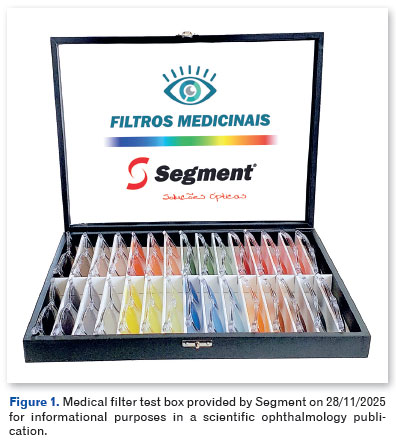
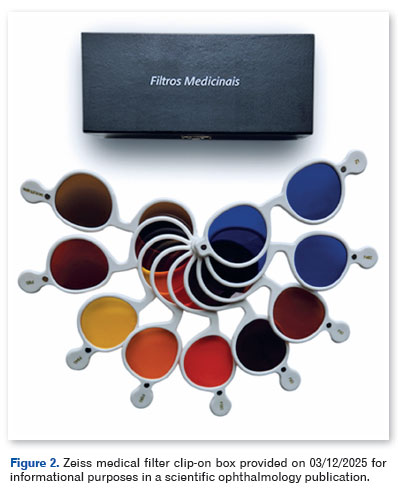
Recent clinical reports show the growing potential of this resource to improve visual quality across a wide range of ophthalmic conditions1,2. The assessment of visual function has long extended beyond visual acuity alone. Qualitative aspects such as contrast sensitivity, color discrimination, and light–dark adaptation are now recognized as important determinants of overall visual performance.
Studies have shown, e.g., that changes in contrast sensitivity can significantly affect reading speed, even in the early stages of diseases such as glaucoma. In this scenario, selecting filter lenses with the potential to optimize contrast (such as yellow hues), accompanied by clinical testing, can improve adaptation accuracy3.
Other relevant indications include the following:
- reducing discomfort caused by disabling photophobia and glare;
- improving chromatic discrimination in red–green axis dyschromatopsia (color blindness)4.
Photophobia: concept and causes
Photophobia is defined as the sensation of ocular discomfort triggered by light5,6. It may result from changes in different structures, including the following:
- Cornea: scars, keratoconus, dry eye, and astigmatism
- Crystalline lens: posterior subcapsular cataract
- Iris: aniridia and coloboma
- Uveal tract: uveitis
- Retina: cone dystrophy, achromatopsia, and Stargardt disease
- Extraocular causes: headaches, sequelae of traumatic brain injury, and blepharospasm5
Among these, retinal causes—particularly achromatopsia—are the most prevalent. Severe photophobia is often disabling and had a direct impact on daily activities, social interaction, and work performance. In such cases, medical filter lenses represent a valuable opportunity to restore quality of life.
Key points for assertive adaptation of medical filter lenses
1. Complete eye examination
Patients who are candidates for medical filter lenses must undergo a full assessment, including refraction, biomicroscopy, tonometry, and fundoscopy. The results of these tests corroborate the diagnosis and guide medical choices. For patients with low vision, testing using a frame and test box is recommended.
Choice of color: optical and spectral properties
2. Color selection must consider the optical properties inherent to hues:
- Red: It has longer wavelengths and lower frequency, which contributes to reduced destabilization of the pigment in the rods. For this reason, it is usually one of the first options for presentation in extreme photophobias, such as achromatopsia. However, it is not the final choice for all patients with this condition and other hues should be tested.
- Yellow: It has the potential to improve contrast sensitivity. It is particularly indicated in pathologies that have a significant reduction in this function (e.g., AMD, glaucoma).
- Filters that block out blue light:
They reduce glare and improve the perception of contrast.
These recommendations serve as a starting point; however, individual patient responses can be highly variable, which reinforces the need for testing with certified filter test boxes available on the Brazilian market, such as those provided by Segment (Figure 1) and Zeiss (Figure 2), shown below:
3. Indoor and outdoor testing
The evaluation must replicate real-life conditions. Darker hues with a high blockage of the visible light spectrum can reduce visual acuity and contrast, making it difficult to move around indoors safely (e.g., Segment’s FC-CZ5 filter lens or the FC-CZ3 + FC-CZ2 combination, was developed for outdoor use only after it was tested in a real environment with patients with achromatopsia.
Knowing the percentage of light transmittance is essential for providing safe guidance to patients.
4. Aesthetic acceptance
Hearing the patient’s opinion is a fundamental part of the adaptation. There are cases in which the patient recognizes a significant improvement in visual comfort but feel insecure or dissatisfied with the appearance of the hue of the selected lens. This preference must be taken into account before the final prescription is made.
The individualized adaptation of medical filter lenses, combined with the systematic testing using certified test boxes, significantly increases the correctness of the prescription and final patient satisfaction, especially due to qualitative improvements in vision.
The implementation of a standardized method, combined with the use of objective and subjective analysis tools, can add substantial value to future investigations into the impact of these lenses on visual quality.
REFERENCES
1. Sanchez-Cano A, Ordina-Hospital E, Aporta J. Colorimetric and Photobiological Properties of Light Transmitted though Low-Vision Filters: Simulated Potencial Impacto n ipRGCs Responses considering Crystalline Lens Aging. Life. 2025:15(2):261.
2. Wilkins AJ, Evans BJW. Other Potential Uses of Coloured Filters in the Clinic. In: Wilkins AJ, Evans BJW. Vision, Reading Difficulties, and Visual Stress. Cham: Springer International Publishing, 2022. p. 293–321. Disponível em:
3. Triantafyllopoulos GI, Karabatsas CH, Pateras E, Chandrinos A, Kapralos D, Georgiou I, et al. Assessment of Visual Function Using Yellow-Tinted filter in Patientes with Pre-Perimetric and Early Open Angle Glaucoma. Clin Optom (Auckl). 2025 Aug 18:17:255-268.
4. Jabbar M, Aslam A, Faryad M, Mehbood A, Zahid N, Amjad M. (2024).Comparative Analysis of Tinted X-Chrome Contact Lenses and Red Filters on Colour Vision Impairment: X-Chrome Lenses and Red Filters on Color Vision. PJHS-Lahore. 2024;5(5):147-152.
5. Katz BJ, Diare KB. Diagnosis, pathophysiology, and treatment of photophobia. Surv Ophthalmol. 2016;61(4):466-77.
6. Reyes N, Huang JJ, Choudhury A, Pondelis N, Locatelli EVT, Hollinger R, et al. FL-41 tint reduces activation of neural pathways of photophobia in patients with chronic ocular pain. Am J Ophthalmol. 2024 Mar:259:172-184.
| INFORMAÇÕES DOS AUTORES |
|
 |
»Mylene Leal Matsuhara https://orcid.org/0000-0002-3539-3444 http://lattes.cnpq.br/4812084763817308 |
Funding: No specific financial support was available for this study.
Conflict of interest: None of the authors have any potential conflict of interest to disclose.
Received on:
December 2, 2025.
Accepted on:
December 11, 2025.
 eOftalmo está licenciada com uma Licença Creative Commons Atribuição-NãoComercial 4.0 Internacional.
 © 2026 Todos os Direitos Reservados


 Ler em português
 Português PDF
 Imprimir
 Enviar este artigo por email
 Como citar este artigo
 Enviar um comentário
 Mendeley
 Pocket
 Compartilhar no Facebook
 Compartilhar no Twitter
 Compartilhar no Linkedin
 Compartilhar no WhatsApp