

Dillan Cunha Amaral1; Richard Daniel Ferreira Reis2; Pedro Lucas Machado Magalhães3; Lidia Cheidde4; Bruna Gabriel Miranda5; Ricardo Noguera Louzada1
DOI: 10.17545/eOftalmo/2026.0005
ABSTRACT
Vision impairment affects more than 2.2 billion people worldwide, underscoring the need for evidence-based guidance in ophthalmology. This bibliometric analysis mapped the 100 most-cited systematic reviews and meta-analyses in the field to identify highest-impact evidence and how research priorities have evolved. Records were retrieved from the Web of Science Core Collection (15 Jan 2025) and ranked by total citations; bibliometric indicators and visualizations were generated with Bibliometrix (R) and VOSviewer. The 100 articles (1992-2023) accrued over 42.000 citations, with output peaking in 2015-2016. Ten journals, led by Ophthalmology (37 papers), hosted 86% of the studies, while 25 countries, 365 institutions and 658 authors contributed. The United States (26 articles) and United Kingdom (22) dominated volume, yet Australia and Singapore produced exclusively multi-country publications, highlighting reliance on global collaboration. The National University of Singapore, University of Melbourne and Johns Hopkins University were the most productive institutions, and Wong T-Y was the leading author (13 papers, >10 000 citations). Keyword and timeline analyses showed a shift from glaucoma-centric topics to population eye-health metrics and therapeutic evidence from randomized trials. Overall, high-impact ophthalmic evidence is increasingly generated through international networks and concentrated in a few specialist journals, guiding future efforts toward collaborative rigorous research.
Keywords: Bibliometric analysis; Systematic review; Meta-analysis; Ophthalmology.
RESUMO
A deficiência visual afeta mais de 2,2 bilhões de pessoas em todo o mundo, o que reforça a necessidade de diretrizes baseadas em evidências na oftalmologia. Esta análise bibliométrica mapeou as 100 revisões sistemáticas e meta-análises mais citadas na área para identificar as evidências de maior impacto e como as prioridades de pesquisa evoluíram. Os registros foram obtidos da Web of Science Core Collection (15 de janeiro de 2025) e classificados pelo total de citações; os indicadores bibliométricos e as visualizações foram gerados com o Bibliometrix (R) e o VOSviewer. Os 100 artigos (1992-2023) acumularam mais de 42.000 citações, com pico de produção em 2015-2016. Dez periódicos, liderados pela Ophthalmology (37 artigos), publicaram 86% dos estudos, com contribuições de 25 países, 365 instituições e 658 autores. Os Estados Unidos (26 artigos) e o Reino Unido (22) dominaram o volume, enquanto a Austrália e Singapura produziram exclusivamente publicações multinacionais, destacando a dependência da colaboração global. A Universidade Nacional de Singapura, a Universidade de Melbourne e a Universidade Johns Hopkins foram as instituições mais produtivas, e Wong T-Y foi o autor principal (13 artigos, >10.000 citações). As análises de palavras-chave e cronologia mostraram uma mudança de foco de tópicos centrados no glaucoma para métricas de saúde ocular populacional e evidências terapêuticas de ensaios randomizados. De modo geral, evidências oftalmológicas de alto impacto são cada vez mais geradas por meio de redes internacionais e concentradas em alguns periódicos especializados, orientando os esforços futuros para pesquisas colaborativas rigorosas.
Palavras-chave: Análise bibliométrica; Revisão sistemática; Meta-análise; Oftalmologia.
INTRODUCTION
The 2019 World Report on Vision by the World Health Organization states that vision impairment affects over 2.2 billion people worldwide, with more than 1 billion cases either preventable or untreated, highlighting the importance of ophthalmology for public health. Higher prevalence rates include myopia, affecting 2.6 billion individuals, presbyopia with 1.8 billion, glaucoma at 76 million, and diabetic retinopathy at 146 million. The same report estimates that preventing vision loss in 11.9 million cases (e.g. glaucoma, diabetic retinopathy, trachoma) could have saved $32.1 billion in healthcare costs1.
In this scenario, evidence-based medicine is a powerful tool to prevent eye disease and guide clinical practice toward the most effective, safe, and cost-effective treatments2-4. Sacket et al. explain that evidence-based medicine combines individual clinical experience with the best available scientific evidence to guide patient care decisions, valuing physician judgment while respecting patient preferences, and using different types of studies5. Systematic reviews and meta-analyses, recognized as level 1 evidence, are at the top of the evidence hierarchy. By integrating qualitative and quantitative data from comparable studies, they provide robust conclusions supported by larger patient samples and enrich the existing literature, increasingly cited in guidelines and clinical practice4.
Bibliometric analysis is a valuable tool for evaluating the quality, quantity, and impact of scientific publications which helps clinicians and researchers identify key publications6. In recent years, bibliometric studies in ophthalmology have increased focusing on various sub-topics, such as myopia, cataracts, glaucoma, dry eye, and pediatric ophthalmology7-20.
This bibliometric analysis is the first to focus on the top 100 systematic reviews and meta-analyses in ophthalmology to provide an overview of global research in the field. Key findings include trends in annual scientific production, institutional contributions, journal output, and leading universities and authors in the field. By examining these parameters, we hope to help consolidate the existing literature, facilitate the dissemination of high-quality evidence to ophthalmologists. provide valuable insights into research, guide future studies, and encourage international collaborations.
METHODS
Data sources and search strategy
The Web Of Science Core Collection (WOSCC) Collection database was accessed on 15 January 2025, with no time of restriction. To minimize bias, articles were identified by two independent researchers (R.D.F.R and B.G.) searching in WOSCC to identify the top 100 cited articles in the area, and any differences were compared and obtained by consensus. The search strategy used to search in title, abstract, author keywords, and keywords plus fields were “systematic review” OR “Systematic reviews” OR “meta-analysis” OR “meta-analyses” in the TOPIC (title, abstract, author, keywords, and keywords plus). Later, the articles were refined by the “ophthalmology” category.
Data collection and bibliometric analysis
A global analysis of articles published in journals was conducted, ranking them in descending order based on their total citation counts. Key information, such as article titles, authors, publication year, country of origin, primary institution, publishing journal, and journal impact factor, was recorded. The H-index was used to evaluate the local impact of the authors, while journal impact factors (IF) were sourced from the SCImago Journal Rank (SJR). Bibliometric indices and visualizations were generated using VOSviewer software (v1.6.20) and the Bibliometrix package in R.21,22 Bibliometrix was employed to examine quantitative bibliometric metrics, including annual publication trends, top authors, countries, journals, and the most frequently cited articles. Meanwhile, VOSviewer enabled co-occurrence analyses to investigate Keywords Plus, institutional partnerships, and co-authorship networks. These tools were chosen for their advanced features in literature mapping and their ability to provide detailed insights into emerging research trends and key focus areas. Bibliometrix was employed to examine quantitative bibliometric metrics, including annual publication trends, top authors, countries, journals, and the most frequently cited articles. Meanwhile, VOSviewer enabled co-occurrence analyses to investigate Keywords Plus, institutional partnerships, and co-authorship networks. These tools were chosen for their advanced features in literature mapping and their ability to provide detailed insights into emerging research trends and key focus areas.
RESULTS
Analysis of annual publications
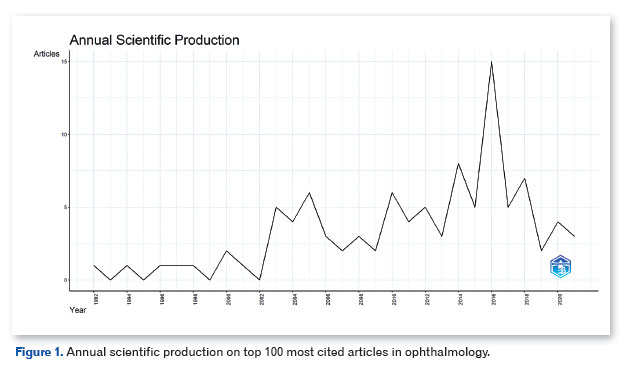
The temporal distribution of the 100 most cited systematic reviews and meta-analyses in ophthalmology is presented in Figure 1. The oldest article in this collection was published in 1992, and since then, a general trend of increasing high-impact publications per year has been observed. Between 1992 and 2000, the number of highly cited articles was low (frequently none or only one per year). From 2001 onward, a more consistent increase began, although with year-to-year fluctuations. This growth intensified during the 2010s, culminating in notable productivity peaks in 2015 and 2016. In 2016, the most productive year, 15 articles from the ranking were published, followed by about 8 articles in 2014. After 2016, the annual number of top 100 publications declined. These findings indicate that the mid-2010s concentrated many of the most influential systematic reviews/meta-analyses, possibly reflecting growing interest in evidence-based medicine in ophthalmology during that period.
Most cited articles and co-authorship
Table 1 compiles the 100 most cited articles, including title, DOI, first author, total citations, publishing journal, and journal impact factor. Among these, the most cited article was published in 2014 in the journal Ophthalmology, with approximately 3.707 citations (about 337 citations per year since publication). The second most cited article was published in 2016 also in Opthalmology, accumulating around 2.851 citations (approximately 316 per year). The third, published in 2011 in the British Journal of Ophthalmology, received about 2.348 citations in total (around 167 annually on average). These impressive figures highlight the high relevance and impact that certain systematic reviews/meta-analyses have achieved in ophthalmology.

Regarding authorship, strong international collaboration was observed among the highest-impact studies. Approximately 45% of these 100 articles involved co-authors from multiple countries, demonstrating the multicentric nature of the most cited research. Conversely, about 55% of the papers had all authors affiliated with the same country. In other words, nearly half of the most cited studies resulted from international collaborations. This underscores the importance of global research networks in ophthalmology: multinational teams have significantly contributed to the field’s most influential work.
Annual citations
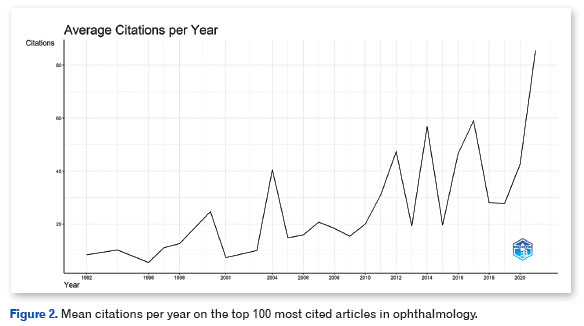
Figure 2 shows the trend of average annual citations for the top 100 articles—that is, the number of citations received per year on average since publication. This metric assesses impact adjusted for time, identifying which publications maintain continued high relevance. Between 1992 and 1998, annual average citations remained low (generally below 10 per year). From 1999, a gradual increase in this index is observed, with fluctuations but an overall upward trajectory. Pronounced peaks are seen in 2004, 2012, 2014 and 2017, years in which articles with exceptionally high citation rates were published. The highest peak of average annual citations occurs around 2021. In summary, this temporal impact analysis suggests that while older classic works continue to be cited, many of the most influential articles have emerged in recent years and are achieving high annual citation rates, reflecting current topics of great interest in ophthalmology.
Analysis of journals
Table 2 presents the 10 leading journals responsible for the highest number of articles among the top 100 cited. In total, 23 different journals published these 100 papers; however, only 10 of them accounted for 86 articles, showing that high-impact production is highly concentrated within a select group of journals.
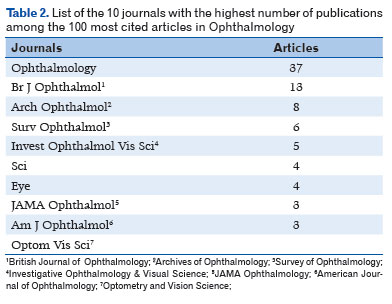
The journal Ophthalmology stands out as the main outlet, publishing 37 of the 100 most cited articles, representing 37% of all works in this ranking. Next, the British Journal of Ophthalmology published 13 articles from the top 100, and Archives of Ophthalmology contributed 8 articles. Notably, the Archives of Ophthalmology ceased publication under this name in 2013 and was rebranded as JAMA Ophthalmology, which continues to publish under the same editorial lineage.
The remaining journals in the top 10—Survey of Ophthalmology, Investigative Ophthalmology & Visual Science (IOVS), Eye, JAMA Ophthalmology, American Journal of Ophthalmology, and Optometry and Vision Science, published between 3 and 6 articles each.
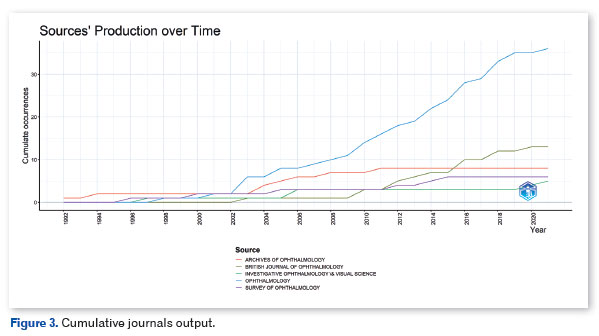
In addition to the raw article count, it is relevant to examine how these journals’ output evolved over time. Figure 3 illustrates the cumulative production of articles (among the top 100) by five key journals from 1992 to 2020: Ophthalmology, Archives of Ophthalmology, IOVS, British Journal of Ophthalmology, and Survey of Ophthalmology. Ophthalmology (blue line) consistently led contributions over recent decades, with a marked increase in cumulative articles especially after 2005. By 2018, Ophthalmology surpassed 30 articles published among the top 100, evidencing its central role in disseminating the most influential research. Archives of Ophthalmology (red line) saw a notable rise from the mid-2000s, and the British Journal (yellow line) shows a slight increase in the late 2010s. This analysis reinforces that Ophthalmology not only published the greatest number of influential works but also consolidated its dominance over time. While the other leading journals are important, their roles have been more modest and gradual. These patterns highlight the importance of specific journals as preferred vehicles for high-impact systematic reviews/meta-analyses in ophthalmology, possibly due to the broad reach and credibility these outlets offer.
Analysis of the universities
The 100 evaluated articles involve authors affiliated with a total of 365 institutions (universities, hospitals, or research centers). Table 3 lists the 10 institutions with the highest presence among high-impact works, measured by the number of top 100 articles in which each institution was represented by at least one author. Institutions from Asia, Oceania, and North America dominate this ranking. The National University of Singapore (NUS) leads the list, participating in 19 of the top 100 most cited articles, followed closely by the University of Melbourne (Australia) with 18 articles and Johns Hopkins University (United States of America - USA) with 17. Harvard University (USA) and the Singapore Eye Research Institute (SERI) each contributed 10 articles. Other notable institutions include the University of Sydney (Australia) with 9 articles, Moorfields Eye Hospital/Institute of Ophthalmology (UK) with 8, Queen’s University Belfast (UK) also with 8, and both Anglia Ruskin University (UK) and Brien Holden Vision Institute (Australia) with 7 articles each.
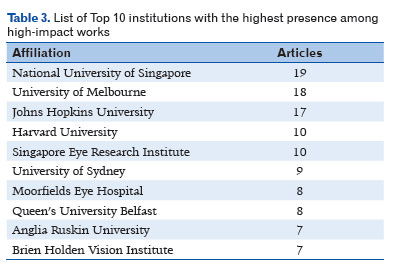
These data show that a few academic centers concentrate much of the influential production: notably, institutions from Singapore, Australia, the UK, and of the USA. The strong presence of NUS and SERI reflects the prominent contribution of researchers from Singapore, especially led by ophthalmologist Tien-Yin Wong (the most productive author—see below). Similarly, the University of Melbourne and the University of Sydney demonstrate Australia’s central role in high-impact collaborative research, while Johns Hopkins and Harvard stand out as the main North American hubs. UK institutions such as Moorfields and Queen’s Belfast also appear prominently.
Figure 4 shows the temporal evolution of the leading institutions’ output from 1992 to 2021. Harvard University (red line) presented continuous and growing contributions, with an increase in articles starting in the mid-2000s, reaching a peak of about 10 accumulated articles by 2007, then it practically stalls. Johns Hopkins University (golden - yellow line) shows an increasing growth since 2003, reaching around 16 accumulated articles by 2018. The trajectory of the National University of Singapore (green line) and Singapore Eye Research Institute (blue line) displayed sharp growth from 2013/2014, reflecting Singapore’s rapid rise in global ophthalmology, leading the global high-impact contributions. The University of Melbourne (purple line) had a slower start with few articles in the 1990s and 2000s but shows acceleration from 2007, increasing its high-impact publication count near the end of the 2010s.
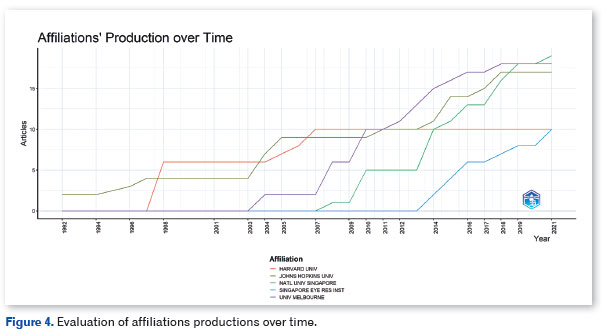
Overall, these trends highlight the dynamics among leading institutions: traditional North American universities (Harvard, Johns Hopkins) lost its dominant presence , while Asia-Pacific institutions (Singapore, Australia) gained prominence mainly over the past decade, evidencing the globalization of ophthalmological research and the emergence of new centers of excellence beyond the traditional USA-Europe axis.
Figure 5 illustrates the co-authorship network among the top publishing institutions (with at least five top-cited articles). Each node represents an institution, while the thickness of the connecting lines denotes the strength of collaboration, measured by co-authorship frequency in the top 100 articles.
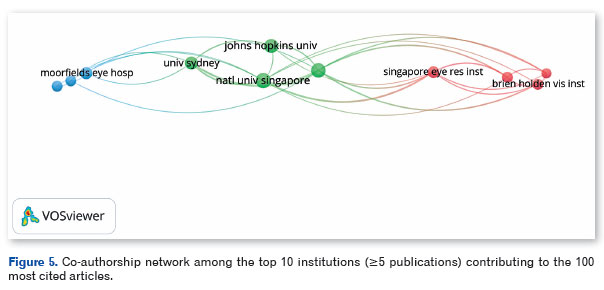
The National University of Singapore and Johns Hopkins University appear as central hubs, maintaining strong bilateral collaborations with institutions from both Asia and Oceania. Notably, the University of Sydney and Singapore Eye Research Institute also show dense connectivity, underscoring their strategic roles in international research partnerships. The visualization suggests three main clusters: one centered around Singaporean institutions (in red), another around Australian collaborators (in green), and a smaller but cohesive UK cluster around Moorfields Eye Hospital (in blue). These clusters not only reflect geographic proximity but also longstanding collaborative ties in ophthalmologic research. In addition to temporal trends, institutional collaboration patterns offer insights into the cooperative structure of high-impact research.
Analysis of trends topics
The analysis of trending topics over time (shown in Figure 6) reveals changes in the most frequent research themes among the high-impact articles. The figure presents a timeline of relevant keywords, where the position and color of the terms approximately indicate the period they were in vogue, while the size reflects frequency of occurrence (number of articles in which they appear). Some topics gained prominence in earlier periods, while others emerged more recently. For example, the term “intraocular pressure” appears predominantly around the mid-2000s (circa 2005–2007), then loses prominence in the following years, likely reflecting great interest in glaucoma and intraocular pressure control in foundational work from that era, followed by relative decline as new focuses emerged. In contrast, terms such as “population,” “visual impairment,” “blindness,” “risk factors,” and “open-angle glaucoma” consistently appear starting around 2014 and remain prevalent in later years. This indicates a sustained emphasis on epidemiological and public health themes in ophthalmology, such as population-based studies of visual impairment and blindness, identification of risk factors, and specific conditions like open-angle glaucoma.
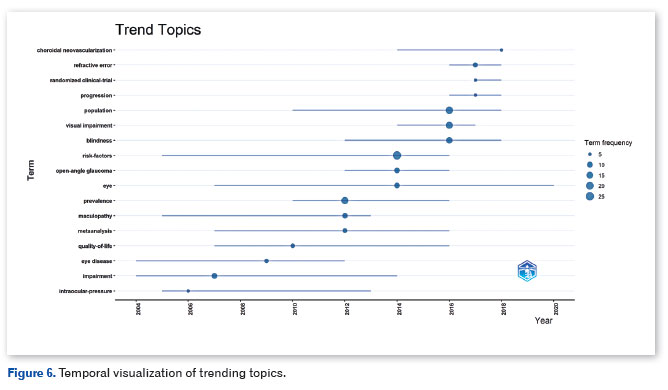
Furthermore, terms like “prevalence” and “maculopathy” (especially associated with age-related macular degeneration) appear regularly during the central portion of the timeline, suggesting continued focus on prevalence studies of ocular diseases and their visual consequences. In more recent years (approximately 2016–2020), new topics emerge such as “choroidal neovascularization” (typical of exudative macular degeneration), “refractive error” (including myopia), and “randomized clinical trial.”
The appearance of terms related to randomized clinical trials (RCTs) suggests that several recent high-impact meta-analyses focused on evidence from RCTs, likely involving new therapies or interventions in ophthalmology (e.g., anti-VEGF studies for choroidal neovascularization or interventions for refractive error correction).
In summary, thematic evolution reflects a shift from classic pathophysiological factors (e.g., intraocular pressure in glaucoma) to a broader population health approach (blindness, risk factors, prevalence), and more recently, toward therapeutic and methodological advances (new interventions evaluated through RCTs). This trend analysis confirms that highly influential ophthalmological research has adapted to emerging challenges in the field, incorporating increasingly important themes such as global blindness, retinal neovascular diseases, and evidence-based medicine via rigorous clinical trials.
Analysis of authors
A total of 658 authors contributed to the 100 most cited articles in ophthalmology. Table 4 highlights the 10 most productive authors, along with their total citations and the year of their first publication in the dataset. High-impact ophthalmological research is, in part, driven by a group of prolific and influential authors.
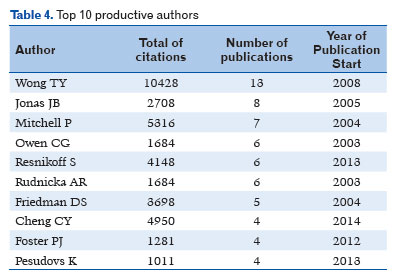
The most productive author is Wong Tien-Yin (Wong TY), with 13 articles among the top 100. His works have amassed a total of 10,428 citations, remarkably surpassing other authors and emphasizing his leading international role in ophthalmic research, particularly in ocular epidemiology and global vision health. Wong’s high-impact publications began in 2008, and since then, he has established himself as the top contributor in both quantity and citation impact. The second most productive author is Jonas Jost B. (Jonas JB), with 8 top 100 articles (2,708 citations), whose first contribution in the dataset dates back to 2005. He is recognized for global studies on prevalence and risk factors for eye diseases. Next is Paul Mitchell (Mitchell P), with 7 highly cited articles (5,316 citations) since 2004, focusing on epidemiological studies, particularly regarding retinal diseases and ocular risk factors.
Other authors with multiple high-impact publications include Cathy Owen (Owen CG), Serge Resnikoff (Resnikoff S), and Angela Rudnicka (Rudnicka AR), each with 6 articles. Resnikoff, for instance, has 4,148 citations (since 2013), reflecting his influence in global blindness and vision health research. Owen and Rudnicka (since 2003) each have 1,684 citations, working primarily on genetic associations and ocular epidemiology in the UK. David S. Friedman (Friedman DS) contributed 5 articles (3,698 citations, first in 2004), focused mainly on glaucoma and global eye health. Four-article contributors include Cheng Ching-Yu (Cheng CY), Paul J. Foster (Foster PJ), and Konrad Pesudovs (Pesudovs K). Notably, Cheng CY’s 4 papers have gathered 4,950 citations, indicating that his publications (mainly on ocular genetics and population-based studies in Singapore) are among the most cited in the dataset. Foster (since 2012) and Pesudovs (since 2013) collected 1,281 and 1,011 citations, respectively, contributing to fields such as glaucoma (Foster) and visual quality of life (Pesudovs).
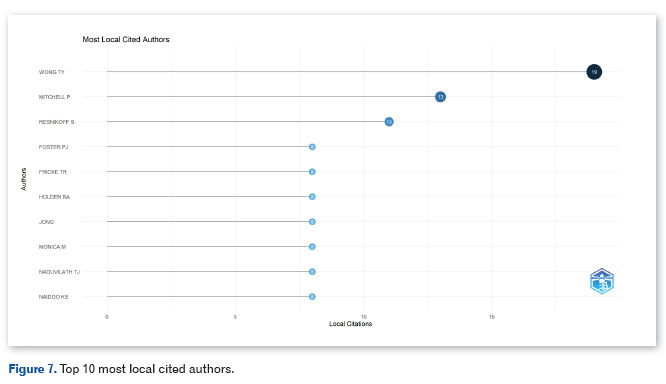
In terms of impact within the dataset (i.e., local citations—how often these articles cite each other), Wong TY also leads with 19 local citations. He is followed by Paul Mitchell (13) and Serge Resnikoff (11). Other authors, though not leading in total output, stand out in local influence: Paul Foster, Timothy R. Fricke, Brien A. Holden, Monica M. Jong, Thanemozhi J. Naduvilath, and Kovin Naidoo each received 8 local citations, indicating that their works are frequently referenced by other top-cited articles (all are associated with global research on refractive errors and avoidable blindness).
These local citation data (summarized in Figure 7) suggest interconnectivity among the top 100 articles: authors such as Wong, Mitchell, and Resnikoff produce foundational studies that serve as conceptual or methodological bases for others, forming a highly referenced literature core. In summary, the author analysis reveals both the key scientific leaders in ophthalmology, whose research volume and global impact are extraordinary, and the network of mutual influence among these high-impact studies, reinforcing the cumulative and collaborative nature of scientific advancement in the field.
Analysis of keywords
These offer a thematic overview of the articles content. To identify the most common topics, a co-occurrence analysis was conducted using terms that appeared in at least 5 articles. A total of 23 keywords met this threshold. Figure 8 graphically displays the co-occurrence network of these 23 terms, nodes represent the keywords, and links indicate joint appearances in the same article (stronger links indicate higher co-occurrence).
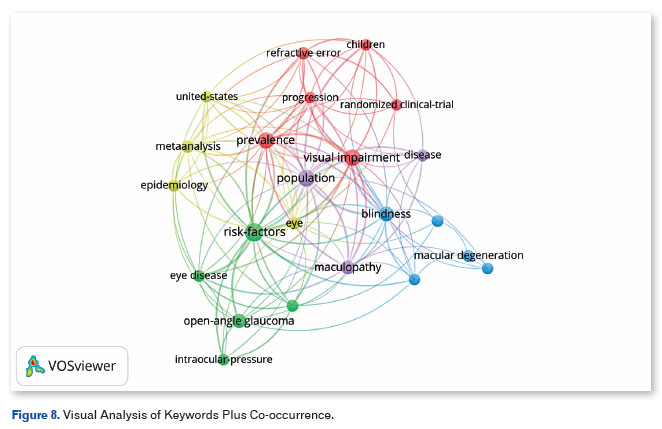
The most frequent terms summarize the primary thematic focuses of the top-cited articles. Broadly, they cluster into three areas: ocular epidemiology, prevalent eye diseases, and methods/interventions. In the ocular epidemiology and global vision health cluster, prominent keywords include “blindness,” “visual impairment,” “prevalence,” “population,” and “risk factors.” These reflect a strong emphasis on disease burden and population-level studies among top-cited works, many of which explore prevalence, risk factors, and visual loss impacts across populations.
In the disease-specific cluster, key terms relate to prevalent ocular conditions: “glaucoma” (often linked with “open-angle glaucoma” and “intraocular pressure”), indicating a focus on glaucoma research and associated risk factors; retinal pathologies like “maculopathy” and “choroidal neovascularization,” are keywords or trending topics suggesting focus on age-related macular degeneration and neovascular complications (Figures 6 and 8).
In the methodology/intervention cluster, terms such as “meta-analysis,” “randomized clinical trial (Figure 8). The presence of “randomized clinical trial” supports the finding that many high-impact reviews/meta-analyses relied on compiling RCT evidence, emphasizing the role of rigorous evaluation of ophthalmic interventions.
In summary, keyword analysis reinforces previous section findings: the most influential ophthalmology articles in recent years focus on major public health challenges (e.g., global blindness, glaucoma, retinal disease) and clinical intervention assessments. The keywords plus analysis provides a thematic summary of the high-impact research landscape.
Analysis of the countries
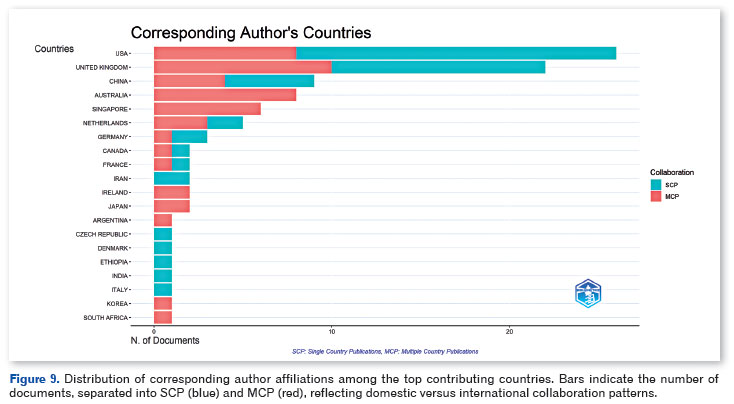
Country of origin (based on corresponding author affiliation) reveals the global distribution of high-impact ophthalmic research, while also highlighting disparities among nations. Among the 100 articles, 25 different countries are represented, emphasizing the multinational nature of highly cited ophthalmology research. Table 5 presents the 10 most represented countries, along with their respective collaboration profiles.
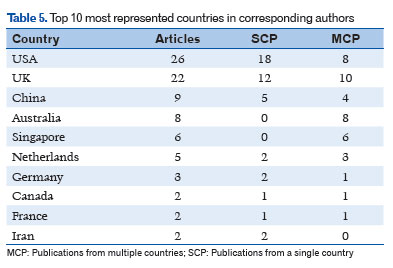
The United States leads with 26 articles (26%), followed by the United Kingdom with 22 (22%). Together, the US and UK account for nearly half of all top 100 articles, underscoring their historical prominence and leadership in ophthalmology research. Other key contributors include China (9 articles), Australia (8), and Singapore (6).
Netherlands and Germany contributed 5 and 3 articles, respectively, while Canada, France, and Iran each contributed 2. These 10 countries collectively account for 85 of the top-cited studies, reinforcing the idea that a relatively small group of nations concentrates most of the globally influential ophthalmic research.
A particularly relevant aspect revealed in this analysis is the variation in international collaboration, measured through the distinction between SCP (Single-country publications) and MCP (Multiple-countries publications). Countries with lower overall output often show a higher proportion of internationally co-authored articles. For instance, both Australia and Singapore had 100% of their articles as MCPs, indicating that all their high-impact studies were developed through international collaborations, likely via research consortia or multinational epidemiological initiatives. The Netherlands also had a notable share of MCPs (60%), while Canada and France each had 50%. This suggests that researchers from these countries frequently seek international partnerships to enhance their scientific visibility and impact.
In contrast, countries with strong domestic research infrastructure, such as the United States and Germany, tend to have a higher proportion of SCPs, indicating a greater capacity to generate high-impact studies through internal resources. Specifically, the US had 18 of its 26 articles (~69.2%) produced without international collaboration, and Germany had 66.7% of its publications authored solely by German researchers. Interestingly, the United Kingdom and China showed a more balanced profile, with about 55% of their output involving MCPs, reflecting both strong national research bases and frequent international engagement. Iran, although contributing only two articles, had both classified as SCPs, suggesting a localized research model.
Figure 9 complements these findings by visually presenting the distribution of SCPs and MCPs among the top contributing countries. It reinforces the central role of high-income nations, especially the US and UK, not only in terms of volume but also in terms of collaboration profiles. While the US dominates in total output, countries like Singapore, Australia, and the Netherlands stand out for their strategic integration into international research networks, evidencing the importance of global cooperation in shaping contemporary ophthalmological science.
DISCUSSION
The present bibliometric analysis provides a comprehensive overview of the top 100 most-cited systematic reviews and meta-analyses in ophthalmology, revealing several important trends across publication outputs, authorship, topics, and collaboration. As the first study to focus specifically on high-impact evidence syntheses in ophthalmology, it extends the scope of prior bibliometric works on subspecialties or general ophthalmic literature23. The key findings show a significant rise in influential publications (especially during the mid-2010s), a concentration of these works in a few leading journals, a globalization of research contributions with notable institutional and national leaders, evolving research themes, and an extensive collaborative network underpinning the field. Taken together, these results reflect the current state of ophthalmology research as one driven by evidence-based practice and international teamwork, addressing global eye health challenges.
Trends in publication and citation patterns
The analysis of annual output demonstrates that highly cited systematic reviews and meta-analyses were relatively scarce before the 2000s, followed by a surge in the 2010s. Notably, the mid-2010s saw the greatest productivity. This spike suggests an inflection point when evidence-based ophthalmology gained substantial momentum, possibly due to growing recognition of the value of systematic reviews in guiding clinical decisions. The timing coincides with broader trends in medicine emphasizing comparative effectiveness research and guideline development.
After 2016, the yearly count of new top-cited papers declined slightly; however, it remained higher than pre-2010 levels (indicating a new plateau of sustained high output).
Citation patterns mirror these publication trends. Earlier seminal reviews (1990s–early 2000s) continue to accrue citations over decades, reflecting their lasting influence. At the same time, many recent articles are achieving very high citation rates shortly after publication, evidenced by peaks in average annual citations around 2013/2014 and especially ~2021. In fact, some reviews published in the late 2010s rapidly amassed hundreds of citations per year, indicating immediate relevance to the field. This dynamic, where classic evidence is continually cited but newly published syntheses quickly become influential underscores a research environment that both honors foundational knowledge and rapidly integrates fresh evidence. It also suggests that ophthalmology, like other disciplines, benefits from the faster dissemination of data in the digital era, where important findings (e.g. global prevalence studies or breakthrough therapy meta-analyses) are quickly recognized and cited by peers. Overall, the temporal analysis reflects an accelerating and cumulative development of the evidence base: ophthalmology entered a phase of exponential growth in high-level evidence production during the 2010s, aligning with an era of heightened evidence-based practice across medicine.
Journal impact and outlet concentration
The dissemination of these top-cited reviews is highly concentrated in a select group of journals. Specialist ophthalmology journals dominate, indicating that authors choose established field-specific outlets to maximize visibility among ophthalmologists. Just 10 journals accounted for 86 of the 100 analyzed papers, while the remaining 14 articles were scattered across 13 other journals. The journal Ophthalmology stands out as by far the most common venue, publishing 37% of all top-100 articles. This finding highlights Ophthalmology (the flagship journal of the American Academy of Ophthalmology) as a premier platform for influential systematic reviews and meta-analyses. Its broad scope and high impact undoubtedly attract major evidence syntheses, and in turn, those publications garner extensive citations. The next most represented journals were the British Journal of Ophthalmology (13 articles) and Archives of Ophthalmology (8 articles), followed by other well-regarded outlets such as Survey of Ophthalmology, Investigative Ophthalmology & Visual Science, JAMA Ophthalmology, American Journal of Ophthalmology, Eye, Optometry and Vision Science. Each of these contributed between 3 and 6 of the top-cited works. Notably, nearly all of these journals are vision science or ophthalmology-specific, underlining that influential evidence syntheses in this field typically reside in domain journals rather than general medical journals. Temporal patterns in journal contributions further emphasize Ophthalmology’s prominence: its cumulative count of top-100 papers grew steeply after 2005 and surpassed 30 by 2018, far outpacing any other journal. Meanwhile, Archives of Ophthalmology and IOVS showed slower growth in their share, and other journals exhibited relatively flat trajectories. These patterns suggest that a few elite journals have become the preferred vehicles for high-impact evidence, likely due to their wide readership, credibility, and indexing, factors that enhance citation potential. From a practical standpoint, this concentration means that clinicians and researchers can survey a handful of leading journals to find the most impactful reviews that shape the field.
Institutional and country contributions
The origins of these influential publications span the globe, yet are dominated by certain academic centers and countries, reflecting both historical research powerhouses and emerging contributors. In total, authors from 25 countries and 365 institutions were involved in the top 100 papers, underscoring that impactful ophthalmic research is a multinational enterprise. Institutionally, a small group of universities and research institutes appears disproportionately frequently. The National University of Singapore (NUS) topped the list, with its researchers involved in 19 of the 100 top-cited studies. Close behind were the University of Melbourne (18 articles) and Johns Hopkins University (17), followed by Harvard University and the Singapore Eye Research Institute (10 each). Other key contributors included the University of Sydney (9 articles), Moorfields Eye Hospital/University College London Institute of Ophthalmology (8), Queen’s University Belfast (8), Anglia Ruskin University (7), and the Brien Holden Vision Institute (7). Many of these leading institutions are recognized centers of excellence in ophthalmology and vision science, and their strong showing in this analysis indicates that they consistently produce or collaborate on work that resonates with the global community. It is notable that the top institutions come from multiple regions – Asia (Singapore), Oceania (Australia), North America (USA), and Europe (UK) are all represented. The prominence of Singapore’s NUS and SERI reflects that country’s investment and leadership in ophthalmic research (indeed, these are closely tied to the productivity of a single influential researcher, Tien-Yin Wong, discussed below). Likewise, Australia’s presence via Melbourne, Sydney, and the Brien Holden Vision Institute highlights that nation’s focus on eye research (particularly in fields like myopia and global vision impairment). The strong showing of Johns Hopkins and Harvard reaffirms the United States’ academic influence, while the inclusion of UK institutions (Moorfields/UCL and Queen’s Belfast, plus Anglia Ruskin via collaborative networks) shows the UK’s high-impact contributions despite a smaller overall volume compared to the US. These findings echo and update earlier bibliometric observations: historically, the United States produced the majority of top-cited ophthalmic papers (86% in one classic analysis of 1975–2006 publications)24. Our results suggest a more internationally distributed landscape in recent years, with Asia-Pacific institutions rising into the top ranks. Indeed, trends over time show that while North American universities maintained a continuous high output from the 1990s onward, Asia-Pacific institutions surged mainly in the last decade. For example, Harvard and Johns Hopkins had steady growth in cumulative top-cited publications from the early 2000s, whereas NUS exhibited a sharp increase only after ~2014, and the University of Melbourne showed acceleration in the late 2010s. This shift signifies the globalization of ophthalmology research, as emerging research hubs outside the traditional US–Europe sphere contribute increasingly to high-level evidence.
At the national level, the United States and United Kingdom are the two leading countries of origin for the top 100 articles, accounting for 26 and 22 articles respectively. Together they contribute nearly half of all papers, underscoring their enduring leadership in ophthalmic science. China ranks next with 9 articles, followed by Australia (8 articles) and Singapore (6). Other countries among the top 10 include the Netherlands (5), Germany (3), Canada (2), France (2), and Iran (2). In total, these ten countries produced 85% of the highly cited reviews, while the remaining 15% came from a long tail of 15 other nations (each with a single paper). The broad participation (25 countries in all) reinforces that influential ophthalmology research is truly international, but the skewed distribution also highlights disparities: a core group of countries drives most of the impactful output. One insight is how collaboration patterns vary by country. We distinguished between publications authored by a single country’s researchers (SCP) versus those involving multiple countries (MCP). Interestingly, countries with smaller publication counts tended to have higher collaboration rates. All of Australia’s 8 top-cited papers and Singapore’s 6 were international collaborations (100% MCP), indicating that these countries achieve impact by partnering globally on every project. The Netherlands also had a high proportion of MCP (60%), and Canada and France each had half of their papers with international co-authors. In contrast, the United States, despite producing the most papers, had the majority of its top articles authored without international collaboration (~69% SCP), and Germany similarly had two of its three articles done domestically. The UK and China fell in between, with around 45% of their top works involving foreign co-authors. These patterns suggest that major research powers like the US (and to some extent China) can often marshal enough internal resources and data to generate high-impact studies independently, whereas researchers in smaller countries frequently join forces across borders to make substantive contributions. Collaboration network analysis further emphasizes this point: the international co-authorship network is anchored by strong links between the US and UK, which form the central axis of collaboration. Both of these countries also serve as frequent partners for Australia, Singapore, and China in multicenter studies, creating a dense network among Anglophone and large-population countries. The UK’s collaborations with Australia and Singapore are notable, reflecting Commonwealth ties and shared projects in global vision epidemiology. The prominence of Singapore and Australia as collaborative nodes (despite their lower solo output) demonstrates how integration into global consortia (such as the Vision Loss Expert Group or other worldwide studies) has allowed those nations to have outsized influence on ophthalmic evidence. Overall, the collaborative networks evident in this analysis illustrate that high-impact ophthalmology research is very much a team effort across nations. The field’s most influential systematic reviews often result from multicenter, international partnerships, leveraging diverse patient populations and expertise to address questions of global significance.
Leading authors and research collaboration
High-impact contributions in ophthalmology are also driven by a group of prolific authors, whose work often spans institutions and countries. In our analysis, 658 individual authors were involved across the top 100 papers, but a small fraction of these researchers contributed multiple landmark studies. The most productive author is Wong Tien-Yin (Wong TY), who authored or co-authored 13 of the top 100 cited reviews. Wong’s publications amassed over 10,000 citations in total – far surpassing any other individual, reflecting his extraordinary impact on the field. This finding is consistent with other bibliometric studies that identified Wong as a leading figure in ophthalmology research25. His contributions, primarily in the realm of ocular epidemiology and global vision health, have clearly shaped current knowledge (for instance, he has been instrumental in global prevalence studies of diabetic retinopathy, myopia, and other major eye conditions). The second most prolific author, Jost B. Jonas, has 8 top-cited publications (≈2,700 citations), focusing on global eye disease burden and risk factors. Paul Mitchell follows with 7 papers (~5,300 citations), largely in epidemiology of retinal diseases and population eye health. Several other authors appear 5 or more times, including Cathy G. Owen, Angela R. Rudnicka, Serge Resnikoff, and David S. Friedman, each of whom contributed between 5 and 6 high-impact studies. These researchers are known for work in areas such as genetic ophthalmology (Owen, Rudnicka), global blindness and vision impairment (Resnikoff, who spearheaded World Health Organization vision initiatives), and glaucoma and public health (Friedman). It is worth noting that many of these prolific authors often collaborate with one another or appear in multi-author consortium papers, indicating that rather than siloed individual efforts, the most impactful research tends to arise from collaborative teams led by experienced investigators. This is further supported by analysis of citation networks within the top 100 articles: authors like Wong, Mitchell, and Resnikoff not only produce highly cited papers but their work is frequently referenced by other top-cited studies, forming a core literature that underpins subsequent research. In fact, several authors (e.g. Paul Foster, Brien Holden, Kovin Naidoo, who are not at the very top by count still show high “local” citation influence, meaning their studies are heavily cited among this group of 100, underscoring a tightly knit network of knowledge. In summary, the author analysis reveals a cadre of influential ophthalmologists driving evidence synthesis, often through global collaborations. This leadership by a few experts, many of whom head major research institutes or consortia, has helped steer the field’s research agenda toward impactful topics.
Keyword and topical trends
The content analysis of keywords illuminates how the focus of high-impact ophthalmic research has evolved over time. By examining frequent Keywords Plus and their co-occurrences, clear thematic clusters emerged that reflect the field’s shifting priorities. Broadly, the early-to-mid 2000s in our dataset were characterized by topics like “intraocular pressure,” “open-angle glaucoma,” and glaucoma-related terms, indicating that glaucoma management (e.g. controlling intraocular pressure) was a prominent concern in influential studies of that era. This aligns with the chronology of major glaucoma trials and the fact that glaucoma was (and remains) a leading cause of irreversible blindness worldwide. As time progresses into the 2010s, there is a noticeable shift toward epidemiological and public health themes: keywords such as “population,” “prevalence,” “blindness,” “visual impairment,” and “risk factors” become prevalent starting around 2010 and continue through the late 2010s. This trend corresponds to the surge in large-scale population-based systematic reviews and meta-analyses. For example, global prevalence studies of vision impairment, meta-analyses of risk factors for diseases like diabetic retinopathy, and projections of disease burden (many of which were indeed among the top-cited papers). These works mirror the global health community’s increasing focus on quantifying and addressing avoidable blindness and vision loss. Alongside those, the 2010s also saw continued interest in retinal diseases: terms like “maculopathy” and specifically “choroidal neovascularization” (a hallmark of exudative age-related macular degeneration) appear in more recent years, reflecting the impact of new interventions (e.g. anti-VEGF therapies) and the meta-analyses evaluating their outcomes. Additionally, towards the late 2010s, methodological terms such as “randomized clinical trial” gain prominence among the keywords. The presence of “randomized clinical trial” and “meta-analysis” as frequent terms underscores that many of these top-cited papers were not just epidemiological surveys but also syntheses of intervention studies, pooling evidence from RCTs to guide treatment. For instance, several high-impact reviews evaluated the efficacy of treatments (from cataract surgical techniques to pharmacotherapies in retina and glaucoma), thus the emphasis on RCT evidence denotes a maturation of the field toward rigorous, controlled evidence for clinical decision-making. The keyword co-occurrence network confirms that these themes cluster together: one cluster centers on global vision epidemiology (“blindness-visual impairment-prevalence-population”), another around glaucoma (“glaucoma-open angle-intraocular pressure”), and another around retinal disease and therapy (“maculopathy-choroidal neovascularization-vascular endothelial growth factor,” etc.). In summary, the topical trends reveal a progression: earlier seminal reviews often tackled pathophysiological or singular clinical issues, whereas more recent influential studies address broader public health questions and therapeutic evaluations. This reflects the field’s response to emerging challenges. For example, recognizing the need to combat the worldwide myopia and diabetes epidemics, and leveraging new treatment modalities, all through the lens of evidence synthesis.
Implications for clinical practice
The dominance of systematic reviews and meta-analyses in citation counts attests to their pivotal role in guiding ophthalmic practice and policy. As level-1 evidence, these studies aggregate data from numerous trials or population studies, providing ophthalmologists with comprehensive evidence on which to base clinical decisions. The fact that many of the top-cited articles deal with prevalence and risk factors of major diseases (like age-related macular degeneration, diabetic retinopathy, glaucoma, and myopia) means that they have likely informed screening guidelines, public health targets, and resource allocation. For example, highly cited global prevalence studies of vision impairment and blindness have fed directly into initiatives like the WHO’s Vision 2020 and Global Vision Report, helping quantify the scope of intervention needed for diseases such as uncorrected refractive error and cataract. Likewise, influential meta-analyses of treatment outcomes (e.g. comparing anti-VEGF agents for macular degeneration or evaluating intraocular pressure-lowering therapies) have been incorporated into clinical practice guidelines, ensuring that patient management in areas from retina to glaucoma is aligned with the best available evidence. Clinicians frequently rely on these summary analyses for decision support, especially in rapidly evolving areas. The surge in evidence synthesis during the 2010s means that by now, most subspecialties in ophthalmology have a foundation of high-level evidence to consult, whether it is for choosing a surgical technique or estimating a patient’s prognosis based on population data. Another practical implication of our findings is the confirmation that key journals (like Ophthalmology or JAMA Ophthalmology) serve as one-stop sources for influential reviews; busy practitioners reading those journals are exposed to the critical evidence that can change practice. Moreover, the global and collaborative nature of these top studies ensures that the conclusions are often broadly generalizable. Multi-country meta-analyses and reviews incorporate data from diverse populations and care settings, making their recommendations applicable to a wide range of clinical contexts worldwide. This is particularly important in ophthalmology, where disease burden and treatment response can vary with demographics and healthcare infrastructure. In summary, the trends identified in this bibliometric study reassure that ophthalmic clinical practice is increasingly evidence-based and globally informed. Patients ultimately benefit from this, as therapies and policies shaped by high-quality evidence are more likely to improve outcomes and address public health needs.
Directions for future research
Understanding the patterns in high-impact research also points to future opportunities and gaps that the ophthalmic community should address. First, the leveling off of top-cited output after the mid-2010s might indicate that the field is ready for a next wave of innovation – future systematic reviews may need to tackle emerging topics that have not yet produced many highly cited works. For instance, areas like ocular genomics, artificial intelligence in ophthalmology, gene and cell therapies, and long-term outcomes of new surgical techniques are all burgeoning domains that could benefit from rigorous meta-analytic synthesis. As these technologies and interventions mature, they will generate data ripe for systematic review; ensuring these are conducted and disseminated in top journals will be crucial. Second, the keyword trends suggest that while traditional causes of blindness and common diseases have been well studied, there is room for more evidence on under-studied conditions or regional issues. Conditions such as neglected tropical eye diseases, outcomes in low-resource settings, or pediatric ocular disorders might be under-represented in the current top 100 and deserve attention through collaborative research efforts. Third, the collaboration analysis implies that international partnerships have been key to impactful studies, future research should continue to strengthen global consortia, especially including researchers from currently under-represented countries. With only 25 countries involved in these top studies, many nations with significant blindness burdens (for example, in Africa or parts of Asia) had little representation among the highest-impact evidence. Facilitating research capacity and inclusion of those regions in multi-center studies could both improve the relevance of findings and increase the global impact of the resulting publications. Additionally, our findings echo the results of broader scientometric studies, emphasizing that countries like China are becoming major contributors; going forward, balancing contributions and fostering knowledge exchange between traditional Western centers and emerging Asian, Latin American, and African centers will enrich ophthalmic research. Finally, an important future direction is to maintain and further improve the quality of systematic reviews and meta-analyses. The prominence of these studies means that their rigor (methodology, bias control, reporting standards) is critical. Recent analyses have noted improvements in practices like pre-registration of review protocols and adherence to reporting guidelines in medicine. Ophthalmology should continue this trajectory: encouraging registration (e.g. in PROSPERO) and transparent methods will enhance credibility and ultimately influence. High-quality evidence syntheses not only garner citations but truly change practice; thus, investing effort in the conduct and methodological innovation of reviews (such as living systematic reviews or individual patient data meta-analyses) will pay dividends in the form of impactful, actionable knowledge.
Limitations
This study has limitations that should be considered when interpreting the findings. While citation count remains a widely used metric to assess impact, it may favor older publications that have had more time to accumulate citations, regardless of methodological quality or real-world relevance. In contrast, recently published reviews of high scientific value may not yet have reached comparable citation levels, potentially leading to their underrepresentation in the analysis.
The use of a single database, the Web of Science Core Collection (WOSCC), although robust and widely adopted in bibliometric research, may still restrict the scope of included articles. Even though WOSCC indexes a large proportion of high-impact journals, relying exclusively on one platform can limit the breadth of the literature retrieved, particularly for interdisciplinary or emerging areas that might be better captured through complementary sources.
It is also important to note that this analysis did not evaluate the methodological rigor, risk of bias, or reporting quality of the included systematic reviews and meta-analyses. Therefore, high citation frequency does not necessarily equate to high scientific validity or adherence to standards such as PRISMA or PROSPERO registration.
Moreover, although international collaboration was explored, the influence of self-citations or citation networks was not assessed, which could potentially inflate the perceived impact of some authors or institutions. Finally, the study focuses on articles published in peer-reviewed journals and indexed in WOSCC, which may inadvertently exclude regionally relevant or gray literature, especially from low-resource settings.
Despite these considerations, the study provides a comprehensive and data-driven overview of high-impact systematic reviews and meta-analyses in ophthalmology, offering useful insights into global research trends, collaborative patterns, and thematic evolution in the field.
In conclusion, this bibliometric study of top-cited systematic reviews and meta-analyses in ophthalmology illuminates the field’s evolution and current priorities. We observed a marked growth in influential evidence publications over the past three decades, peaking in the mid-2010s alongside an embrace of evidence-based medicine. A small number of prestigious journals and prolific authors, often working in global collaborations, have driven much of this impact. The leading contributing institutions and countries span multiple continents, indicating a globalizing research landscape where traditional leaders (US/UK) now share the stage with Asia-Pacific and other regions. The thematic analysis shows that ophthalmology research has progressively shifted to address broad public health concerns and to evaluate interventions with rigorous methodology, reflecting the community’s commitment to reducing vision loss worldwide. These findings portray a field that is both rooted in high-quality evidence and dynamically responding to new challenges.
By highlighting trends in publication, authorship, and collaboration, our study provides researchers, clinicians, and policymakers with insight into how ophthalmic knowledge is generated and disseminated. Importantly, the results underscore that collaborative, global efforts and adherence to best research practices are key to producing impactful research. Such efforts ultimately translate into better clinical care, guiding prevention strategies, informing treatment guidelines, and improving patient outcomes on a global scale. Future bibliometric updates should continue to monitor these patterns, as they will signal how ophthalmology is adapting to emerging technologies and health issues. As the field moves forward, maintaining a focus on collaborative, high-quality evidence generation will be essential in meeting the vision needs of an aging and growing world population. The present analysis not only catalogues past and present achievements but also lays a foundation for shaping the next generation of ophthalmology research toward areas of greatest impact.
REFERENCES
1. World Health Organization;World report on vision;Geneva 2019. ISBN: 978-92-4-151657-0.
2. Ratnani I, Fatima S, Abid MM, Surani Z, Surani S. Evidence-Based Medicine: History, Review, Criticisms, and Pitfalls. Cureus. 2023;15(2):e35266.
3. Bates DW, Kuperman GJ, Wang S, et al. Ten commandments for effective clinical decision support: making the practice of evidence-based medicine a reality. J Am Med Inform Assoc. 2003;10(6):523-30.
4. Burns PB, Rohrich RJ, Chung KC. The levels of evidence and their role in evidence-based medicine. Plast Reconstr Surg. 2011;128(1):305-310.
5. Sackett DL, Rosenberg WM, Gray JA, Haynes RB, Richardson WS. Evidence based medicine: what it is and what it isn’t. BMJ. 1996;312(7023):71-2.
6. Ellegaard O, Wallin JA. The bibliometric analysis of scholarly production: How great is the impact? Scientometrics. 2015;105(3):1809-1831.
7. Xun Q, Mei W, Zhang X, Pang Y, Yu J. Frontiers of myopia research in the 21st century: A bibliometric analysis of the top 100 most influential articles in the field. Medicine (Baltimore). 2024;103(42):e40139.
8. Idriss LT, Hussain M, Khan M, et al. Mapping of global research output in congenital cataracts from 1903 to 2021. Medicine (Baltimore). 2021;100(48):e27756.
9. Shu X, Liu Y, He F, Gong Y, Li J. A bibliometric and visualized analysis of the pathogenesis of cataracts from 1999 to 2023. Heliyon. 2024;10(4):e26044.
10. Chen S, Huang L, Li X, Feng Q, Lu H, Mu J. Hotspots and trends of artificial intelligence in the field of cataracts: a bibliometric analysis. Int Ophthalmol. 2024;44(1):258.
11. Ullah Z, Tao Y, Mehmood A, Huang J. The Role of Gut Microbiota in the Pathogenesis of Glaucoma: Evidence from Bibliometric Analysis and Comprehensive Review. Bioengineering (Basel). Oct 24 2024;11(11)doi:10.3390/bioengineering11111063
12. Li R, Liu H, Zhang K, Lu Z, Wang N. Global tendency and research trends of minimally invasive surgery for glaucoma from 1992 to 2023: A visual bibliometric analysis. Heliyon. Aug 30 2024;10(16):e36591.
13. Schargus M, Kromer R, Druchkiv V, Frings A. The top 100 papers in dry eye - A bibliometric analysis. Ocul Surf. Jan 2018;16(1):180-190.
14. Nichols JJ, Morgan PB, Jones LW, Efron N. 21st century bibliometric analysis of the field of dry eye disease. Clin Exp Optom. 2021;104(5):639-640.
15. Boudry C, Baudouin C, Mouriaux F. International publication trends in dry eye disease research: A bibliometric analysis. Ocul Surf. 2018;16(1):173-179.
16. Wang S, Zheng W, Li T, et al. Global research hotspots and trends in anti-inflammatory studies in dry eye: a bibliometric analysis (2004-2024). Front Med (Lausanne). 2024;11:1451990.
17. Jia Q, Wang X, Li X, et al. Analysis of research hotspots and trends in pediatric ophthalmopathy based on 10 years of WoSCC literature. Front Pediatr. 2024;12:1405110.
18. Oydanich M, Schott B, Wagner RS, Guo S. Bibliometric Analysis of the Top 100 Cited Articles in Pediatric Ophthalmology. J Pediatr Ophthalmol Strabismus. 2023;60(5):330-336.
19. Wu XY, Fang HH, Xu YW, Zhang YL, Zhang SC, Yang WH. Bibliometric analysis of hotspots and trends of global myopia research. Int J Ophthalmol. 2024;17(5):940-950.
20. Mu J, Zhong H, Zeng D, et al. Research trends and hotspots in the relationship between outdoor activities and myopia: A bibliometric analysis based on the web of science database from 2006 to 2021. Front Public Health. 2022;10:1047116.
21. Van Eck NJ. VOSviewer Manual. In: Waltman L, editor.: University of Leiden; 2019.
22. Aria M, Cuccurullo C. bibliometrix: An R-tool for comprehensive science mapping analysis. Journal of Informetrics. 2017;11(4):959-975.
23. Thanitcul C, A. K, Justin GA, et al. A Bibliometric Analysis of the 100 Most Cited Articles in Cornea. Cornea Open. 2023;doi:10.1097/coa.0000000000000021
24. Ohba N, Nakao K, Isashiki Y, Ohba A. The 100 most frequently cited articles in ophthalmology journals. Arch Ophthalmol. 2007;125(7):952-60.
25. Fu Y, Mao Y, Jiang S, Luo S, Chen X, Xiao W. A bibliometric analysis of systematic reviews and meta-analyses in ophthalmology. Front Med (Lausanne). 2023;10:1135592.
| AUTHORS INFORMATIONS |
|
 |
» Dillan Cunha Amaral http://orcid.org/0009-0002-7948-154X https://lattes.cnpq.br/7959357721386149 |
 |
» Richard Daniel Ferreira Reis http://orcid.org/0009-0007-6152-1802 http://lattes.cnpq.br/4334407300946205 |
 |
» Bruna Gabriel Miranda http://orcid.org/0009-0003-0282-816X http://lattes.cnpq.br/7041355292262374 |
 |
» Pedro Lucas Machado Magalhães http://orcid.org/0009-0004-1840-2953 http://lattes.cnpq.br/1140240260236564 |
 |
» Lidia Cheidde http://orcid.org/0009-0000-7282-9131 http://lattes.cnpq.br/0222770911783131 |
 |
» Ricardo Noguera Louzada http://orcid.org/0000-0002-9610-5768 https://lattes.cnpq.br/5978866539118374 |
Funding: No specific financial support was available for this study.
Conflict of interest: None of the authors have any potential conflict of interest to disclose.
Received on:
August 6, 2025.
Accepted on:
October 15, 2025.
 eOftalmo está licenciada com uma Licença Creative Commons Atribuição-NãoComercial 4.0 Internacional.
 © 2026 Todos os Direitos Reservados


 Ler em português
 Português PDF
 Imprimir
 Enviar este artigo por email
 Como citar este artigo
 Enviar um comentário
 Mendeley
 Pocket
 Compartilhar no Facebook
 Compartilhar no Twitter
 Compartilhar no Linkedin
 Compartilhar no WhatsApp