

Gabriel Vinícius Trindade de Abreu1; Carolina Menezes Dutra1; Victor Souza Mares1; Camila Trindade de Abreu2
DOI: 10.17545/eOftalmo/2026.0006
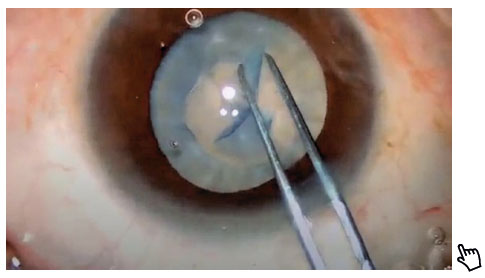
Continuous curvilinear capsulorhexis CCC is a critical step in phacoemulsification and has a direct impact on the safety of the procedure and on the centering and stability of the intraocular lens1. For medical residents, the challenge is rarely “knowing the steps” but rather performing the capsulorhexis with fine control under magnification, where micromovements and tremor can alter the traction vector and compromise the quality of the capsular compromise the capsulorhexis edge and shape2. From an ergonomic standpoint, there is evidence that grip adjustments, finger positioning, and the use of hand rests reduce the impact of tremor and improve precision in ophthalmic microsurgery2. In addition, controlled studies using virtual reality simulation have demonstrated improved performance and a reduction in capsulorhexis failure in the operating room, supporting structured training for safer learning from the very first cases3,4. In this video, these principles are applied in day-to-day clinical practice. It demonstrates a recommended grip for the Utrata capsulorhexis forceps and a nucleus chopper, with proper finger ergonomics and pivoting movement at the incision to control the instrument tip with minimal excursion5. Through observation and training, the aim of the video is to standardize a starting point, accelerate the learning curve, and ensure surgical safety from the very first cases.
REFERENCES
1. Centurion V, Lacava AC, Caballero JC. A capsulotomia descontínua durante a facoemulsificação. Rev Bras Oftalmol. 2011;70(6):367-370.
2. Singh G, Wong JJW, Sun MT, Casson R, Selva D, Chan WO. Overcoming the impact of physiologic tremors in ophthalmology. Graefes Arch Clin Exp Ophthalmol. 2022;260(12):3723-3736.
3. McCannel CA, Reed DC, Goldman DR. Ophthalmic surgery simulator training improves resident performance of capsulorhexis in the operating room. Ophthalmology. 2013; 120(12):2456-2461.
4. Daly MK, Gonzalez E, Siracuse-Lee D, Legutko PA. Efficacy of surgical simulator training versus traditional wet-lab training on operating room performance of ophthalmology residents during the capsulorhexis in cataract surgery. J Cataract Refract Surg. 2013;39(11):1734-1741.
5. Lin HY, Chuang YJ, Tang X, Lin CC, Chen HY, Lin PJ. Pivot concept: achieving a good-quality capsulorhexis through a 2.2 mm or less clear corneal incision by using standard capsulorhexis forceps. Int J Ophthalmol. 2017;10(7):1175-1177.
| INFORMAÇÃO DOS AUTORES |
|
 |
» Gabriel Vinícius Trindade de Abreu https://orcid.org/0000-0001-9150-3356 http://lattes.cnpq.br/4186045804298717 |
 |
» Carolina Menezes Dutra https://orcid.org/0009-0002-5411-4524 http://lattes.cnpq.br/9438300962257873 |
 |
» Victor Souza Mares https://orcid.org/0009-0009-9121-3004 http://lattes.cnpq.br/4183301583366614 |
 |
» Camila Trindade de Abreu https://orcid.org/0009-0001-9486-6934 http://lattes.cnpq.br/6537600602351183 |
Funding: No specific financial support was available for this study.
Conflict of interest: None of the authors have any potential conflict of interest to disclose.
Received on:
December 4, 2025.
Accepted on:
December 16, 2025.
 eOftalmo está licenciada com uma Licença Creative Commons Atribuição-NãoComercial 4.0 Internacional.
 © 2026 Todos os Direitos Reservados


 Ler em português
 Português PDF
 Imprimir
 Enviar este artigo por email
 Como citar este artigo
 Enviar um comentário
 Mendeley
 Pocket
 Compartilhar no Facebook
 Compartilhar no Twitter
 Compartilhar no Linkedin
 Compartilhar no WhatsApp