

Rafaela Malagoli dos Santos; Taciana Bretas Guerra; Paula dos Santos Ribeiro Laborne de Mendonça
DOI: 10.17545/eOftalmo/2024.0031
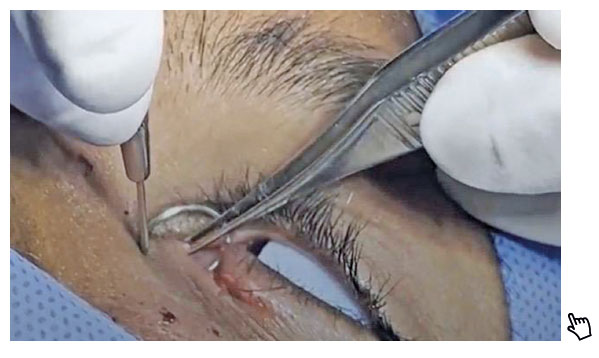
Eyelid trauma with canalicular laceration is an ophthalmic emergency requiring prompt diagnosis and treatment to preserve the function of the lacrimal system and prevent late complications1-3. These lacerations are commonly caused by blunt or penetrating trauma to the medial eyelid region and are often associated with domestic, sports, or road accidents2,3. The case shown in the video involves a pet dog bite, a trauma mechanism that frequently causes complex eyelid injuries2.
A thorough clinical assessment is essential, and any wound near the medial canthus should raise suspicion of canalicular involvement1,3. Diagnosis can be confirmed by probing and irrigation of the lacrimal system1. Standard treatment involves early surgical reconstruction, ideally within 24–48 h after trauma, ensuring proper anatomical repair and canalicular intubation to maintain lacrimal system patency1-4.
Employing the correct approach significantly reduces the risk of chronic epiphora, canalicular stenosis, and eyelid deformities, thereby improving both functional and cosmetic outcomes1,3-5.
REFERENCES
1. Hawes MJ, Segrest DR. Effectiveness of bicanalicular silicone intubation in the repair of canalicular lacerations. Ophthalmic Plast Reconstr Surg. 1985;1(3):185-190.
2. Kersten RC, Kulwin DR. “One-stitch” canalicular repair. A simplified approach for repair of canalicular lacerations. Ophthalmology. 1996;103(5):785-9.
3. Al-Battashy A, Al-Mujaini AS. Canalicular lacerations: techniques used and timing to intervene. Oman J Ophthalmol. 2023;16(2):201-204.
4. American Academy of Ophthalmology. Basic and Clinical Science Course (BCSC), Section 07: Oculofacial Plastic and Orbital Surgery. Chapter: Lacrimal System - Canalicular lacerations. San Francisco: American Academy of Ophthalmology.
5. Murchison AP, Bilyk JR. Canalicular laceration repair: an analysis of variables affecting success. Ophthalmic Plast Reconstr Surg. 2014;30(5):410-414.
| AUTHORS INFORMATION |
|
 |
»Rafaela Malagoli dos Santos https://orcid.org/0000-0001-9085-2300 http://lattes.cnpq.br/7093405466169862 |
 |
» Taciana Bretas Guerra https://orcid.org/0009-0005-3864-7349 http://lattes.cnpq.br/0078894933055708 |
 |
» Paula dos Santos Ribeiro Laborne de Mendonça https://orcid.org/0009-0004-2626-6082 http://lattes.cnpq.br/8665588576522838 |
Funding: The authors declare no funding.
Conflicts of interest: The authors declare no funding.
Received on:
December 3, 2025.
Accepted on:
December 17, 2025.
 eOftalmo está licenciada com uma Licença Creative Commons Atribuição-NãoComercial 4.0 Internacional.
 © 2026 Todos os Direitos Reservados


 Ler em português
 Português PDF
 Imprimir
 Enviar este artigo por email
 Como citar este artigo
 Enviar um comentário
 Mendeley
 Pocket
 Compartilhar no Facebook
 Compartilhar no Twitter
 Compartilhar no Linkedin
 Compartilhar no WhatsApp