

Heloiza Favaro Hammerschmidt1; Beatriz Panka Archegas2; Roberto Del Claro Hopker3; Louise Hernandes Claure3; Luisa Moreira Hopker1
DOI: 10.17545/eOftalmo/2024.0024
ABSTRACT
Cavernous sinus venous thrombosis (CST) is a rare but potentially severe condition that can lead to irreversible visual loss. During pregnancy, the risk of thromboembolic events is significantly higher, making CST an important differential diagnosis in women presenting with headache and visual disturbances. We report the case of a 31-week pregnant woman with systemic lupus erythematosus who presented with sudden headache and binocular diplopia. Ophthalmologic examination revealed third cranial nerve palsy associated with anisocoria and mydriasis. The patient received enoxaparin anticoagulation but developed visual acuity loss. After pregnancy interruption and magnetic resonance imaging confirmation, she was treated with high-dose intravenous methylprednisolone followed by tapering oral corticosteroids. She achieved full recovery of visual acuity and resolution of ocular motor deficit. This case highlights the importance of early suspicion and combined therapy in pregnant patients presenting with neurological and ocular signs suggestive of CST.
Keywords: Cavernous sinus thrombosis; Pregnancy; Strabismus; Visual acuity; Systemic lupus erythematosus.
RESUMO
A trombose venosa de seio cavernoso (TVSC) é uma condição rara e potencialmente grave, que pode resultar em perda visual irreversível. Durante a gestação, o risco de eventos tromboembólicos é significativamente maior, o que torna a TVSC um diagnóstico diferencial importante em pacientes com cefaléia e alterações visuais. Relatamos o caso de uma gestante de 31 semanas, portadora de lúpus eritematoso sistêmico, que apresentou cefaléia súbita e diplopia binocular. O exame oftalmológico revelou paralisia do III par craniano com anisocoria e midríase. A paciente recebeu anticoagulação com enoxaparina, porém evoluiu com queda da acuidade visual. Após interrupção da gestação e confirmação diagnóstica por ressonância magnética, foi instituída pulsoterapia com metilprednisolona, seguida de corticoterapia oral regressiva. Houve recuperação completa da acuidade visual e regressão do déficit motor ocular. O caso ilustra a importância da suspeição diagnóstica precoce e do tratamento combinado em gestantes com sinais neurológicos e oculares sugestivos de TVSC.
Palavras-chave: Trombose do seio cavernoso; Gravidez; Estrabismo; Acuidade visual; Lúpus eritematoso sistêmico.
INTRODUCTION
Cavernous sinus thrombosis (CST) is a rare condition, with an estimated annual incidence of 0.2 to 1.6 cases per 100,000 individuals. Most cases occur due to infectious causes, but aseptic etiologies such as trauma, surgery, pregnancy, and systemic lupus erythematosus (SLE) have also been reported.1 Diagnosis is based on clinical history, physical examination, and imaging studies, particularly magnetic resonance imaging. Treatment of aseptic forms consists of anticoagulation and, in refractory cases, systemic corticosteroid therapy.2
CASE REPORT
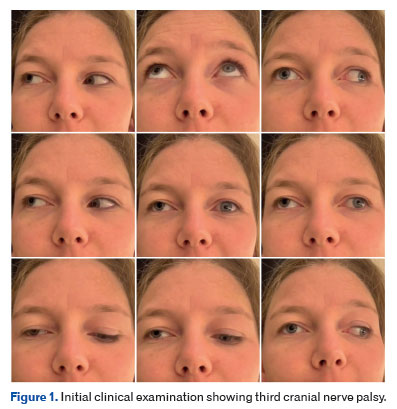
A 31-week pregnant female patient with a history of SLE under treatment with hydroxychloroquine presented with sudden headache and binocular diplopia. Ophthalmologic examination revealed third cranial nerve palsy, with 30 prism diopter exotropia and 30 prism diopter right hypertropia (XT30/HTD30) at both distance and near, as well as anisocoria and right-sided mydriasis (Figure 1). Initial visual acuity was 20/20 in both eyes, and fundus examination showed no abnormalities.
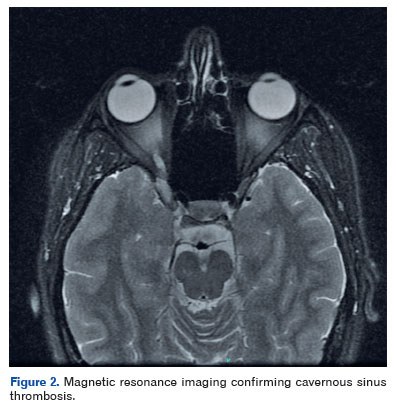
Initial imaging suggested cavernous sinus thrombosis (CST), and anticoagulation with enoxaparin was initiated. After 40 days, the patient experienced visual acuity deterioration in the right eye (20/100), associated with optic disc pallor, without signs of optic disc edema at any point during follow-up. Due to the severity of the condition, after multidisciplinary evaluation, pregnancy interruption was indicated at 36 weeks, which allowed for contrast-enhanced magnetic resonance imaging, confirming the diagnosis of CST (Figure 2).
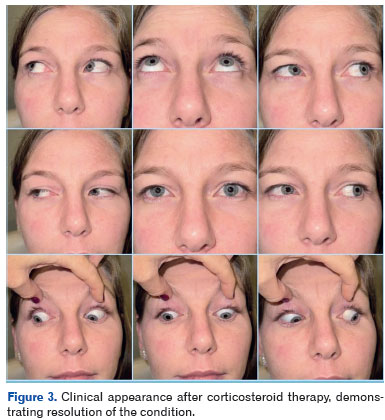
In the absence of an infectious cause, high-dose intravenous methylprednisolone pulse therapy (1 g/day for 3 days) was administered, followed by oral prednisone 1 mg/kg/day with gradual tapering. The patient showed complete recovery of visual acuity (20/20) and regression of third cranial nerve palsy (Figure 3). A follow-up magnetic resonance imaging performed 10 months after the acute event demonstrated findings compatible with partial recanalization of the right ophthalmic vein compared with the previous study.
DISCUSSION
CST results from thrombus formation in the cerebral venous system or dural sinuses, with risk factors including dehydration, third trimester of pregnancy, puerperium, coagulation disorders, autoimmune diseases, malignancies, and upper respiratory tract infections.1,2,3
In pregnant women, headache is the most frequent symptom (73%), while visual disturbances may occur in up to 27% of cases. Diagnosis is often delayed, as symptoms may be misattributed to conditions such as preeclampsia or post-dural puncture headache.4
Anticoagulation therapy with low-molecular-weight heparin is recommended and considered safe during pregnancy and the puerperium.4 However, in severe or refractory cases such as the one reported here, corticosteroid therapy may be required.1 Particularly in patients with SLE in remission, after excluding an infectious etiology.
In this case, the likely mechanism involved inflammatory compression at the orbital apex secondary to the thrombotic process, evidenced by significant clinical improvement following systemic corticosteroid therapy. Previous reports describe unfavorable outcomes in patients with CST associated with SLE, highlighting the importance of early intervention.
Previous reports describe unfavorable outcomes in patients with CST associated with systemic lupus erythematosus (SLE), highlighting the importance of early intervention. This case documents complete neurological and visual recovery after combined therapy, an outcome rarely reported in the literature, and represents the first described case of third cranial nerve palsy due to CST during pregnancy.
CONCLUSION
This case highlights the importance of considering CST as a differential diagnosis in pregnant women with severe headache and visual symptoms. Early and multidisciplinary management, with anticoagulation and corticosteroid therapy in selected cases, can result in full recovery and prevent irreversible sequelae.
AUTHOR CONTRIBUTIONS:
Substantial contribution to conception and design: Roberto Del Claro Hopker; Louise Hernandes Claure.
Acquisition of data: Heloiza Favaro Hammerschmidt; Beatriz Panka Archegas, Luisa Moreira Hopker.
Analysis and interpretation of data: Heloiza Favaro Hammerschmidt; Beatriz Panka Archegas; Roberto Del Claro Hopker; Louise Hernandes Claure; Luisa Moreira Hopker,
Drafting of the manuscript: Heloiza Favaro Hammerschmidt; Beatriz Panka Archegas; Roberto Del Claro Hopker; Louise Hernandes Claure; Luisa Moreira Hopker.
Critical revision of the manuscript for important intellectual content: Luisa Moreira Hopker.
Have given final approval of the submitted manuscript (mandatory participation for all authors): Heloiza Favaro Hammerschmidt; Beatriz Panka Archegas; Roberto Del Claro Hopker; Louise Hernandes Claure; Luisa Moreira Hopker.
Statistical analysis: Heloiza Favaro Hammerschmidt; Beatriz Panka Archegas; Roberto Del Claro Hopker; Louise Hernandes Claure; Luisa Moreira Hopker.
Obtaining funding: - Administrative, technical, or material support supervision: Heloiza Favaro Hammerschmidt; Luisa Moreira Hopker.
Research group leadership: Heloiza Favaro Hammerschmidt; Luisa Moreira Hopker.
REFERENCES
1. Plewa MC, Hall WA. Cavernous Sinus Thrombosis. In: StatPearls [Internet]. Treasure Island (FL): StatPearls Publishing; 2025.
2. Darmawan G, Hamijoyo L, Oehadian A, Bandiara R, Amalia L. Cerebral Venous Sinus Thrombosis in Systemic Lupus Erythematosus. Acta Med Indones. 2018;50(4):343-345.
3. Herrera-Salgado, Jésser M., Guzmán-Monteón, Elena, Salceda-Muñoz, Pedro A. T., Cortés-González, Daniel I., Reyes-Mendoza, Luis E., Ángeles-Vázquez, María de J., Briones Garduño, Jesús C., Mendieta-Zerón, Hugo, Malagón-Reyes, Ricardo M., & Castorena-de Ávila, Rubén. (2024). Cerebral venous thrombosis in obstetrics: literature review and clinical case reports. Revista médica del Hospital General de México, 87(2), 80-95. Epub; 2024.
4. Roeder HJ, Lopez JR, Miller EC. Ischemic stroke and cerebral venous sinus thrombosis in pregnancy. Handb Clin Neurol. 2020;172:3-31. doi:10.1016/B978-0-444-64240-0.00001-5
| AUTHORS INFORMATIONS |
|
 |
» Heloiza Favaro Hammerschmidt http://lattes.cnpq.br/6031525196406112 http://orcid.org/0009-0004-8470-6015 |
 |
» Beatriz Panka Archegas http://lattes.cnpq.br/1115646601746671 http://orcid.org/0009-0009-5985-889X |
 |
» Luisa Moreira Hopker http://lattes.cnpq.br/7383295373537539 http://orcid.org/0000-0001-6875-9820 |
 |
» Roberto Del Claro Hopker http://lattes.cnpq.br/8102936153276401 http://orcid.org/0009-0001-6208-4743 |
 |
» Louise Hernandes Claure http://lattes.cnpq.br/5920663075807426 http://orcid.org/0000-0002-4643-191X |
Funding: No specific financial support was available for this study.
Conflict of interest: None of the authors have any potential conflict of interest to disclose.
Received on:
January 10, 2023.
Accepted on:
September 24, 2023.
 eOftalmo está licenciada com uma Licença Creative Commons Atribuição-NãoComercial 4.0 Internacional.
 © 2026 Todos os Direitos Reservados


 Ler em português
 Português PDF
 Imprimir
 Enviar este artigo por email
 Como citar este artigo
 Enviar um comentário
 Mendeley
 Pocket
 Compartilhar no Facebook
 Compartilhar no Twitter
 Compartilhar no Linkedin
 Compartilhar no WhatsApp