

Leopoldo Ernesto Oiticica Barbosa1; Rodrigo Lindenmeyer2; Núbia Vanessa Lima3; Wilma Lelis Barboza4; Izabela N. F. Almeida5; Helmann Cavalcanti6
DOI: 10.17545/eOftalmo/2026.v12.0009
Este artigo pertence à Edição Especial SLT no Glaucoma: Da Prática Clínica à Perspectiva de Implementação no SUS
ABSTRACT
Selective laser trabeculoplasty (SLT) has emerged as a safe and effective treatment option for the management of glaucoma, with the potential to reduce reliance on chronic pharmacological therapy. Despite strong scientific evidence, the adoption of SLT in Brazilian clinical practice is still heterogeneous and limited by factors beyond technical expertise. This study comprehensively reviews and analyzes the experience of experts from the five regions of Brazil in a round table format, addressing current indications, cultural and structural barriers, impact on patients' quality of life, and challenges to large-scale implementation. The analysis showed that the main obstacle to the expansion of SLT in the country arises from the interaction between medical training, healthcare system organization, and funding models. By integrating different regional perspectives, this study proposes a practical reflection on the role of SLT in the Brazilian context and highlights its importance as a potential public health and sustainability strategy for the treatment of glaucoma.
Keywords: Glaucoma; Selective laser trabeculoplasty; Cost-effectiveness; Unified Health System.
RESUMO
A trabeculoplastia seletiva a laser (SLT) consolidou-se como uma alternativa eficaz e segura no manejo do glaucoma, com potencial de reduzir a dependência de terapias medicamentosas crônicas. Apesar da robustez das evidências científicas, sua incorporação na prática clínica brasileira ainda é heterogênea e limitada por fatores que vão além do conhecimento técnico. Este artigo reúne a experiência de especialistas das cinco regiões do Brasil em formato de mesa-redonda, explorando indicações atuais, barreiras culturais e estruturais, impacto na qualidade de vida dos pacientes e desafios para implementação em larga escala. A análise evidencia que o principal entrave para a expansão do SLT no país reside na interação entre formação médica, organização do sistema de saúde e modelos de financiamento. Ao integrar diferentes perspectivas regionais, o trabalho propõe uma reflexão prática sobre o papel do SLT no contexto brasileiro e reforça sua relevância como estratégia potencial de saúde pública e sustentabilidade no tratamento do glaucoma
Palavras-chave: Trabeculoplastia seletiva a laser; Glaucoma; Sistema Único de Saúde; Custo-efetividade; Acesso à saúde.
INTRODUCTION
Selective laser trabeculoplasty (SLT) combines a rare set of attributes for the treatment of glaucoma: proven clinical efficacy, a good safety profile, and the potential to reduce reliance on chronic drug therapy. However, its adoption in Brazil is still limited, and, in most cases, it plays a secondary role in clinical practice.
This discrepancy between its recommended use based on scientific evidence and actual use is not just explained by technical issues. Structural barriers, funding models, professional training, and cultural perceptions of glaucoma treatment are interrelated, and these factors help understand why SLT has yet to become a first-line treatment in the country.
Experts from all five regions of Brazil took part in this round table discussion: Dr. Rodrigo Lindenmeyer (South), Dr. Wilma Lelis (Southeast), Dr. Núbia Vanessa (Center-West), Dr. Izabela Almeida (North), and Dr. Helmann Cavalcanti (Northeast). Based on their clinical and institutional experiences, they discussed the current role of SLT in the management of glaucoma in the country (Figure 1).

Rather than reaffirming previously established benefits, the debate addresses the limitations, training challenges, and risks of use of SLT without clear criteria. By bringing together converging and diverging views, this forum aims to move beyond the question "Does SLT work?" The discussion proposes a more comprehensive reflection: how, for whom, and under what conditions SLT may be appropriately integrated into glaucoma patient care within the Brazilian context.
Question 1: When you think of SLT today, what type of patient comes first to mind?
The responses from the five experts demonstrated strong agreement regarding the main indications for SLT, despite differences in clinical nuances and real-world settings. In general, the ideal patient profile can be divided into two large groups: the newly diagnosed patient (treatment-naive) and the patient who already has difficulties using eye drops.
For the newly diagnosed patient, the indication of SLT as first-line treatment was widely supported. Dr. Izabela and Dr. Rodrigo highlighted, in particular that patients with ocular hypertension or mild to moderate primary open-angle glaucoma should receive SLT. Dr. Rodrigo added that the ideal scenario is when an average reduction of 25%–30% from baseline pressure is sufficient to reach the patient's individualized target. Dr. Helmann also stressed that newly diagnosed patients who need to initiate treatment are typically the first who come to mind.
Dr. Wilma agreed with this indication for initial treatment, especially for patients who would require one or two medications. However, she stressed an important clinical consideration: the patient should be in an early or moderate stage and able to tolerate potential transient spikes in intraocular pressure following the procedure. She also highlighted the conditions that respond well to the laser, such as eyes with greater trabecular pigmentation and corticosteroid-induced glaucoma.
The second largest group includes patients already undergoing medical treatment. Dr. Núbia highlighted that those for whom the laser allows discontinuation of eye drops, thus reducing the monthly cost of treatment, could benefit from SLT. Moreover, Dr. Izabela and Dr. Wilma mentioned patients who experienced side effects, intolerance, poor adherence, or difficulty in having ongoing access to medication, for whom SLT can reduce reliance on pharmaceutical therapy.
In this context, Dr. Rodrigo and Dr. Helmann see SLT as a useful strategy for therapeutic intensification. Instead of using additional eye drops, the laser helps improve the control of ocular pressure and also reduces the medication load.
Finally, Dr. Núbia drew attention to the daily reality of Brazilian practices: although SLT is widely recognized as an excellent initial option, many patients who visit a specialist are already chronic users of eye drops. In such cases, the patients are not presented with SLT as the first-line treatment for the disease.
Questions 2 and 3: Why does SLT still play a secondary role despite favorable evidence? Is the nature of the current medical resistance to SLT mainly scientific, cultural, or organizational?
When discussing the reasons for SLT remaining underused in Brazil, the five experts presented a clearly multifactorial scenario wherein medical myths, structural limitations, and funding models are interrelated.
Dr. Núbia pointed out that the cultural barrier exists practically nationwide. According to her, there still exists among many ophthalmologists the ingrained view that glaucoma should initially be treated solely with eye drops and that laser treatment or surgery should be used in more advanced stages of the disease.
This opinion is shared by Dr. Wilma, who stated that SLT is simply not on the mind of many general ophthalmologists. She believes that scientific resistance—linked to insufficient in-depth knowledge about the technique—continues to have a significant influence. In addition, she mentioned a few practical aspects of the private healthcare sector: the high cost of the equipment for occasional use and the concern among some physicians that referring patients for the procedure might result in losing them to follow-up.
Dr. Izabela agreed that there is a well-established tradition of initiating treatment with eye drops before considering laser treatment, but she also included the patient's perspective in this discussion. According to her, the very word "laser" still evokes concern among the lay public as it is often associated with invasive procedures, which confirms the need for greater public education.
When the discussion turned to infrastructure, Dr. Rodrigo presented important differences within the country itself. In the large state capitals, the main barrier tends to be cultural, marked by a certain therapeutic inertia. In smaller cities, the problem is often structural because the high cost of the equipment is often not economically viable. He also highlighted an educational consideration: few residency programs offer structured training in SLT, which restricts adequate training in patient selection (Figure 2).
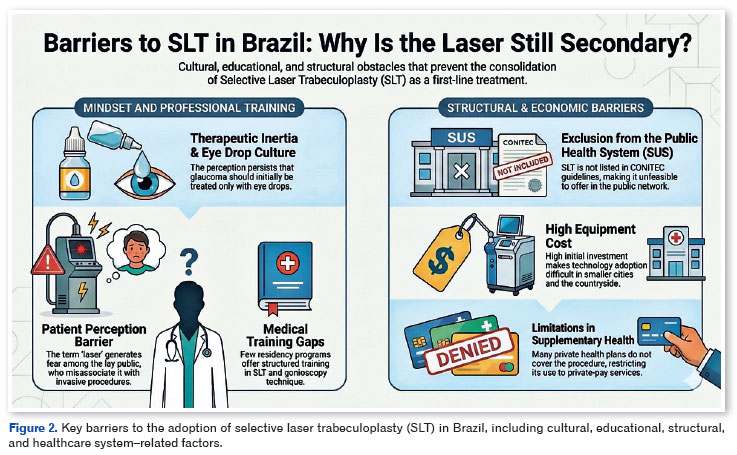
For Dr. Helmann, however, the main obstacle in Brazil is still of an organizational nature. According to him, the public system lacks the organization to adopt the method. In practice, if the access to SLT for ophthalmologists working for the Unified Health System (SUS) was as easy as it is to request diagnostic tests, their interest in the method would naturally increase. As Dr. Núbia summed up, without an adequate organization, it is impossible for scientific knowledge to be translated into clinical practice.
Question 4: In your experience, what changes most in a patient's life when you prescribe SLT instead of eye drops?
When discussing the impact of SLT on the daily life of glaucoma patients, the experts agreed on a key point: the main gain is in quality of life. Moreover, different dimensions of quality of life were highlighted, from eye drop discontinuation to physical and financial effects.
For Dr. Rodrigo, the change can be summed up in two words: freedom and safety. He stated that many patients end up becoming "hostages to the bottle of eyedrops," having to organize schedules, supplies, and travel around their medication. Because forgetfulness is inevitable, ocular pressure control can be compromised. According to him, the advantage of SLT is that it offers continuous pressure stability, regardless of the patient's discipline.
Dr. Helmann agreed and said that even when patients only have to take one drop per day, many perceive the chronic use of eye drops as a constant nuisance. Acceptance of the laser treatment procedure is usually very high in the face of the real possibility of reducing or stopping the medication after the procedure.
In addition to the freedom from chronic medication, there are physical advantages. Dr. Núbia reminded us that prolonged use of eye drops is often associated with ocular hyperemia, surface symptoms, and discomfort. With the reduction or withdrawal of medication after SLT, many patients show functional and aesthetic improvements. Dr. Izabela and Dr. Wilma confirmed this aspect, highlighting the relief associated with the reduction of side effects and intolerance to medication. Dr. Izabela added that good ocular pressure control helps increase the patient's confidence in the treatment.
Another relevant point raised by Dr. Núbia was the socioeconomic impact of the treatment: removing one or two eye drops from the chronic medication provides significant relief for the family budget, especially in a country where many patients cannot use medication consistently due to financial constraints.
On the other hand, Dr. Wilma drew attention to a behavioral risk that requires clinical vigilance. Once patients stop using eye drops, they may think that they are "cured" and relax in their ophthalmologic follow-up. She also noted that, in private practice, patients may experience temporary discomfort should the procedure be repeated in the future.
Question 5: How much of the success of SLT depends more on the physician's expertise, and how much depends more on the patient's profile?
On this issue, there was a fairly clear consensus among the experts. Dr. Wilma stated that the success of SLT depends approximately 30% on the technique and 70% on ocular conditions, indicating that the patient's anatomical and clinical profile is the main determinant of the treatment outcome.
Dr. Rodrigo explains that laser application is relatively simple and reproducible and has a short learning curve. The decisive factor, according to him, is careful patient selection for the procedure—taking into account the type of glaucoma, basal pressure, stage of the disease, and degree of trabecular pigmentation. As he pointed out, when the patient's profile is not adequate for the treatment, even a well-executed technique tends to produce limited results.
Dr. Núbia agreed with this view and confirmed that a correct indication is fundamental. In situations such as inflammatory glaucoma or narrow angle, SLT tends to show unsatisfactory results, regardless of the physician's technical skill.
Even so, Dr. Izabela and Dr. Helmann stressed that the technique should not be neglected. Dr. Izabela noted that inadequate execution can compromise the outcome even in good candidates. Dr. Helmann expanded on this idea by pointing out that the technique begins before the laser is fired, involving careful assessment of the trabecular meshwork, detailed gonioscopy, pigmentation analysis, and appropriate energy titration for each case.
In summary, the experts agreed that expertise in the technique is an essential factor for the procedure, while the choice of the patient largely determines the success of the treatment.
Question 6: Do you believe that every general ophthalmologist should offer SLT, or should this be restricted to centers with high procedural volumes and specialized training?
This question was probably the one that most divided the experts, highlighting the delicate balance between increasing access to SLT and ensuring safety in the indication and execution of the procedure.
On the one hand, there was clear support for the decentralization of the procedure. Dr. Rodrigo argued that SLT should not be restricted to large centers, especially in a country of continental dimensions like Brazil. According to him, concentrating the procedure in highly specialized departments limits access for patients who live outside the capital cities. Considering that the technique has a relatively short learning curve, he believes that general ophthalmologists with adequate training, mastery of gonioscopy, and defined patient selection criteria can safely perform the procedure.
Dr. Izabela shared this view, pointing out that increasing access to SLT might significantly impact glaucoma control among the population, thereby reducing chronic dependence on medication. Dr. Wilma agreed with this perspective by stating that every ophthalmologist who sets out to treat patients with glaucoma should have SLT in their therapeutic arsenal to either perform it or indicate it appropriately.
On the other hand, Dr. Helmann and Dr. Núbia reminded the limitations in the training of many general ophthalmologists. Dr. Helmann pointed out that gonioscopy, an essential examination for the correct indication of SLT, is still not practiced by many professionals, even during training. In clinical routine, he said, tests such as optical coherence tomography are commonly ordered, while detailed evaluation of the angle ends up being neglected.
Dr. Nubia proposes an intermediate path. For her, the general ophthalmologist has a fundamental role to play in the identification and early referral of patients, taking advantage of the wide reach of the specialty across the country. However, the procedure should preferably be performed by glaucoma specialists, who are better prepared to deal with potential complications, such as hypertensive spikes or therapeutic failures.
In summary, there was a consensus that training in SLT should be part of all ophthalmologists' curricula. The disagreement arose mainly over who performs the procedure: properly trained general ophthalmologists or specialists with specific expertise in glaucoma.
Question 7: Many people say that SLT is a simple procedure. In practice, where do you see your colleagues go wrong the most?
When the word "simple" comes up in the discussion, Dr. Núbia leaves an important note by avoiding classifying any medical procedure as such, pointing out that they all require learning, technique, and preparation to address potential complications.
Nevertheless, there was a consensus among the experts that the main error related to SLT in Brazil does not occur at the time of laser application but in the clinical decision that precedes the procedure. Dr. Izabela, Dr. Rodrigo, and Dr. Núbia agreed that the most frequent problem is late or inappropriate indication.
According to Dr. Izabela, many colleagues overextend the clinical treatment with eye drops, missing the ideal moment to prescribe the laser treatment. As a result, the patient is seen with advanced glaucoma and uncontrolled pressure, when surgical intervention would have often been more appropriate. Dr. Rodrigo reinforced this idea, noting that SLT is still seen by some physicians as just another step in the medication sequence. When used as a third- or fourth-line therapy, the required pressure reduction often exceeds the potential of the procedure.
In addition to the timing of the indication, Dr. Rodrigo drew attention to another important flaw: the neglect of gonioscopy. Properly assessing the angle not only helps predict the response to treatment but is also key to avoiding the indication of SLT in cases wherein it is not appropriate or is contraindicated.
Dr. Helmann noted a practical aspect related to the application strategy. According to him, a relatively common mistake is to perform the bilateral procedure simultaneously. He prefers to treat one eye initially and observe the therapeutic response before treating the second eye, to avoid simultaneous corneal or refractive changes that might cause bilateral discomfort.
Finally, Dr. Wilma made an interesting observation about her clinical practice: she rarely sees patients who have previously undergone SLT. The few patients that she saw had had the procedure performed by specialists. For her, these observations show how SLT is still not widespread among general ophthalmologists in many regions of the country.
Question 8: From the patient's point of view, what are the main concerns and obstacles to SLT today, compared to the chronic use of eye drops?
When the discussion shifted to the patient's perspective, the experts converged on one key point: the main barrier remains the fear associated with the word "laser." According to them, the population's lack of knowledge about the technology often creates an initial resistance even before any medical explanation.
Dr. Rodrigo noted that the use of eye drops has been consolidated for decades and is familiar to most people, conveying a sense of control and safety. SLT, on the other hand, has little presence in the popular imagination. Thus, when patients hear the word "laser," they automatically associate the procedure with something aggressive or invasive, generating fear.
Dr. Helmann reports feeling the same apprehension, even when he explains that the procedure is quick, conducted in the office, and allows immediate return to work. He compared this reaction to laser capsulotomy: in this case, acceptance is usually greater because the patient notices an immediate visual improvement. In SLT, because the aim is to reduce intraocular pressure—a benefit that is not directly perceptible—acceptance tends to be lower.
Dr. Núbia added that any treatment perceived as "new" can make patients feel unsure. However, she also noted that acceptance improves when the physician explains, in simple terms, that the procedure only facilitates the drainage of fluid from the eye to protect the optic nerve and that ophthalmologists have decades of experience in trabeculoplasty.
In addition to the fear of the procedure, Dr. Izabela and Dr. Wilma pointed out another important factor: the unpredictability of the therapeutic response. Dr. Izabela pointed out that individual patient response is unpredictable and that the need to counsel patients on potential side effects—albeit rare—requires a cautious approach. Dr. Wilma added that, in private practice, this uncertainty is further compounded by the cost of the procedure, which might increase patients' hesitation when making a decision.
Question 9: In your region, is the experience with SLT different between public hospitals and private clinics? How does this difference translate into practice?
When analyzing access to SLT in the different health systems, the experts drew a clear picture of inequality in Brazil. The consensus was that there is a strong contrast between the public and private sectors, which leads to significant asymmetry in access to care.
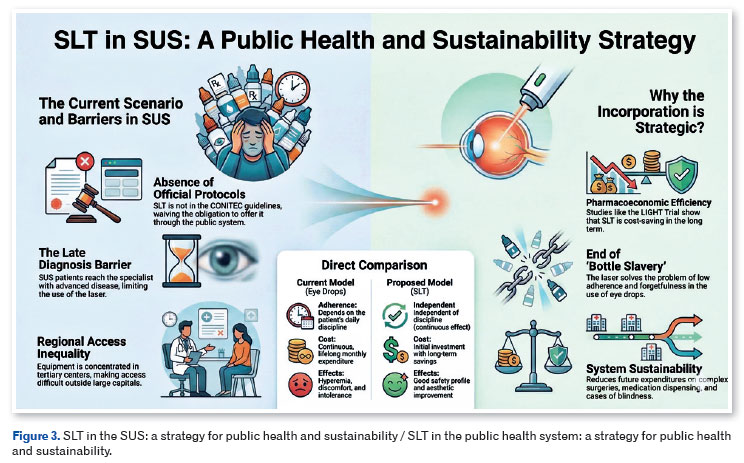
In the SUS, the scenario described was one of limited or no use of the procedure. Dr. Izabela, Dr. Núbia, and Dr. Wilma reported that SLT is simply not available in the public healthcare sector in their regions. Dr. Wilma mentioned that, in an area with more than 2.5 million inhabitants, there are SUS services that provide eye drops, but none offer laser treatment. Dr. Núbia and Dr. Rodrigo explained that the main reason for this discrepancy is organizational: SLT has not yet been integrated into the SUS guidelines by CONITEC and is not part of the official clinical protocols, which means that the public system is not obligated to offer it.
Access remains limited even in the exceptional centers that have the equipment. Dr. Helmann reported that, in Recife, there is a device that was probably acquired partly with government funding, while Dr. Rodrigo mentioned that in Rio Grande do Sul, only one public hospital has the equipment. In both cases, the problem is that this equipment is concentrated in tertiary centers. In practice, many SUS patients only come to these centers when they have advanced glaucoma, at which stage, SLT is often no longer the best treatment.
In the private sector, the reality is more heterogeneous. The experts from the South and the Center-West regions reported a more positive experience. Dr. Rodrigo said that in Rio Grande do Sul, including in smaller inland cities, access to SLT is relatively widespread in the private sector and is often covered by health insurance. Dr. Núbia reported a similar scenario in Brasília, where access to the procedure is becoming increasingly widespread.
On the other hand, in the Northeast and part of the Southeast, the availability of equipment does not always translate into clinical use. Dr. Helmann explained that private clinics in Recife have the device, but it is underutilized due to the low indication rates, and, above all, the cost must be paid directly by the patient. Dr. Wilma stated that in smaller cities within the Rio–São Paulo axis, the equipment was installed years ago but is not covered by private health insurance, remaining largely restricted to private patients and thus underutilized.
In summary, the debate highlighted a striking contrast: while SUS patients rarely have access to SLT and remain dependent on drug treatment, access in the private sector varies across regions, with availability in some but underutilization in others due to funding constraints.
Question 10: If you had 30 seconds with a Ministry of Health policymaker, what would they need to understand about SLT that they currently do not?
To close the round table, we asked the experts to summarize, in a few words, the main argument they would present to a public health manager. The call was practically unanimous: the integration of SLT in the SUS is no longer merely a clinical issue but has become a strategic decision for public health and financial sustainability.
Dr. Izabela and Dr. Rodrigo based this argument on pharmacoeconomics. Dr. Rodrigo pointed out that most patients seen in the SUS do not have advanced disease but rather ocular hypertension or mild to moderate glaucoma, often taking one or two medications. For this predominant profile, SLT addresses directly one of the system's biggest challenges: low adherence to the daily use of eye drops. He reminded us that robust evidence, such as the LiGHT Study1 and analyses of cost-effectiveness adapted to the Brazilian reality, demonstrate that the procedure becomes cost-saving in the long term. Dr. Izabela summed up this reasoning: investing in SLT today will reduce future costs with complex surgeries, reduce the continuous dispensing of eye drops, and prevent cases of irreversible blindness.
Dr. Wilma and Dr. Helmann reinforced this argument from the perspective of clinical practice. Dr. Wilma pointed out that one of the great advantages of SLT in the context of public health is that it reduces dependence on the patient's daily adherence to treatment and avoids the chronic side effects associated with eye drops. Dr. Helmann agreed and added an essential point: for access to be real, it is not sufficient to incorporate the technology - the procedure needs to be adequately reimbursed by the SUS, ensuring viability for services and professionals.
Finally, Dr. Núbia made an analogy with the evolution of cataract surgery in the public system. Just as older and modern techniques coexist in the SUS today, the incorporation of SLT does not mean abandoning eye drops or other laser-based methods, but rather recognizing the natural evolution of medicine. For her, managers need to understand that SLT represents this technological update, offering efficacy, safety, and repeatability.
The final message from the experts was clear: adopting SLT in the public system is not just treatment innovation but also a rational public health strategy that slows the progression of the disease while optimizing resources and preserving the quality of life of an increasingly long-lived population (Figure 3).
REFERENCE
1. Gazzard G, Konstantakopoulou E, Garway-Heath D, et al. Laser in Glaucoma and Ocular Hypertension (LiGHT) Trial: Six-Year Results of Primary Selective Laser Trabeculoplasty versus Eye Drops for the Treatment of Glaucoma and Ocular Hypertension. Ophthalmology. 2023;130(2):139-151.
| AUTHOR INFORMATION |
|
 |
» Leopoldo Ernesto Oiticica Barbosa http://lattes.cnpq.br/3386099226524481 http://orcid.org/0000-0002-6112-8409 |
 |
» Rodrigo Lindenmeyer http://lattes.cnpq.br/8675227269827306 http://orcid.org/0000-0002-6541-5261 |
 |
» Izabela N. F. Almeida http://lattes.cnpq.br/1740867152012675 https://orcid.org/0000-0001-7968-2427 |
 |
» Helmann Cavalcanti http://lattes.cnpq.br/0952655416055652 http://orcid.org/0009-0003-8122-9885 |
 |
» Núbia Vanessa Lima http://lattes.cnpq.br/5133156989383305 http://orcid.org/0000-0003-3693-1934 |
 |
» Wilma Lelis Barboza http://lattes.cnpq.br/7647287686911668 http://orcid.org/0009-0002-4756-9723 |
Funding: No specific financial support was available for this study.
Conflict of interest: None of the authors have any potential conflict of interest to disclose.
Received on:
March 19, 2026.
Accepted on:
March 24, 2026.
 eOftalmo está licenciada com uma Licença Creative Commons Atribuição-NãoComercial 4.0 Internacional.
 © 2026 Todos os Direitos Reservados


 Ler em português
 Português PDF
 Imprimir
 Enviar este artigo por email
 Como citar este artigo
 Enviar um comentário
 Mendeley
 Pocket
 Compartilhar no Facebook
 Compartilhar no Twitter
 Compartilhar no Linkedin
 Compartilhar no WhatsApp